

1. Introduction
Maintaining the stability of the tunnel face during excavation is an important engineering design problem in difficult grounds since in these geotechnical conditions failure at the face can progress quickly and cause the complete tunnel collapse or an unacceptable land subsidence when the work is carried out at shallow depth.
The application of tunnel reinforcing techniques, such as jet grouting arch, steel pipe umbrella and precutting in advance, can reduce the problem of stability in radial direction, but longitudinal movements are still difficult to control if the section
is large and/or the ground is particularly poor.
It has recently been introduced in tunnelling practice the use of reinforced fiberglass pipes or bars into the core to be excavated as a preventive support layout. This technique, initially developed jointly with the mechanical precut in clay, has been widely applied to other geotechnical conditions as the only type of reinforcement or joined with other ground pre-consolidation and/or reinforcement techniques (e.g. steel pipes or jet-grouting umbrella).
Therefore it can be said that the knowledge of the behavior of the mass portion, ahead the tunnel face, in ground with poor geotechnical characteristics, constitutes an indispensable premise for a correct
design of the supports, of the possible reinfor-cement of the ground to be excavated, of the best sequence of operative stages, of the admissible distance from the face and the supports and of the excavation section (full face or staged excavation).
On the other hand it is necessary to know, if reinforcement with fiberglass is to be used the stability improvement effect which is obtained.
Since the stress and displacement condition ahead the tunnel face is three-dimensional the study can be done only using numerical models. In this work the effect of a systematic tunnel face bolting has been studied using a three-dimensional FLAC code by comparing different geometry of reinforcement layout and different geomechanical ground properties. The approach has allowed to put in evidence the improvement on the stability conditions also with the comparison of some measurements carried out in the real tunnel taken as example.
2.Three dimensional numerical model
The problem of face stability conditions and the effect of longitudinal face reinforcement has been studied in this work by means of numerical model analyses especially carried out using a three- dimensional Finite Difference code (FLAC-3D) (ITASCA, 1993).
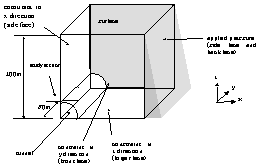
The set-up model (100 m high; 100 m wide; and 100 m long) is based on the geometry and geo-technical parameters found in a tunnel in Italy where face reinforcing has been widely used. On this basis a systematic parametric analysis has been performed allowing a very good general overview of the behavior of the tunnel face reinforcement.
The numerical model geometry is that of a circular tunnel of 12 m diameter with 100 m overburden (undisturbed stress condition hydrostatic with  v =
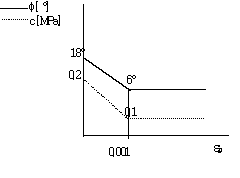
v = o =1.9 MPa) while the geotechnical parameters are those of the Variegated Clay formation (Argille Varicolori) obtained with laboratory tests but two different ground behavior have been analysed (this choice was taken to verify the influence of the adopted ground behavior on the numerical analysis results). The geotechnical properties adopted in the analyses are given in Table 1.
The excavation method foresees full face advancement in the ground that has preventively been reinforced with a fiber glass pipes layout. The tunnel support is obtained by modeling the shotcrete, installed at the same step of the excavation and the final lining installed a step after (that is to say that in the reference section (located in the middle of the model) the final lining is installed at a distance of 1m from the tunnel face).
The modeled pipes behavior is described by an elastic law and the sliding parameters are chosen to prevent any sliding between the bolts and the rock mass.
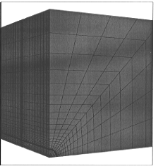
Fig. 2 shows the model dimensions, boundary conditions and the mesh scheme. The scheme of the modeled excavation and support phases and model types are given in Table 2 and 3.
3.Analysis of results
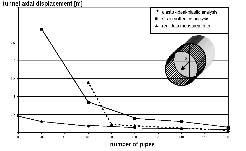
The extension of the plastic zones for the various analysis ahead the tunnel face, measured along the axis of the tunnel is described in fig. 3. It is possible to note that the results without pipes of the numerical model and of those of the simpler convergence-confinement approach are in good agreement.
It can also remarked the great influence on the results of the adopted rock mass mechanical behavior that is bigger for a reduced number of pipes on the face. The choice of an elasto-ideally plastic model therefore can lead to wrong results if the rock mass behavior is strain softenig. For obtaining displacements values of the same entity of the strain softening model the cohesion of the ideally plastic model must be 10 times lower.
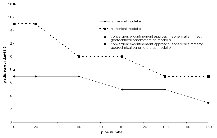
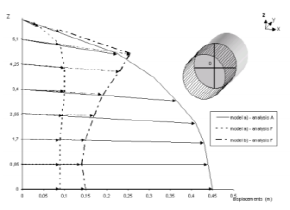
The displacements at the tunnel face are given in fig. 4 and 5. It can be observed from fig. 5 that the strain softening models give quite good results if compared with the real site measurements. The general trend of the measured and computed values show a global behavior with a well defined elbow which represent the point after which the face reinforcing cannot control any more face displacement extrusion: small variation in the ground properties can lead to the collapse of the face. Therefore the safety factor of the tunnel face must be defined with reference to the distance from the elbow value.
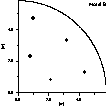
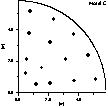
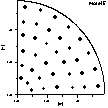
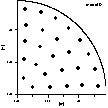
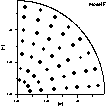
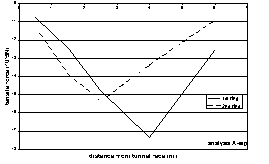
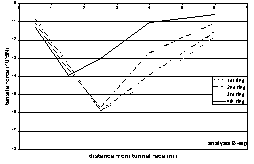
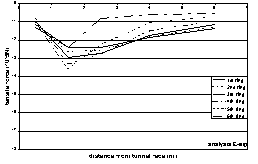
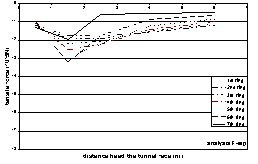
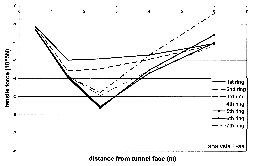
Figure 6a, 6b and 6c show the computed stresses inside the bolts. It can be observed these stresses are not homogeneous at the face, varying with their location at the face. Increasing the bolt number, the axial force induced inside the bolts decreases. Comparing analysis F for ideally elasto-plastic model and strain softening model it can be observed that the stress strain low adopted for the ground, strongly modify the maximum axial force induced inside the bolts.
4. Conclusions
The main conclusions on tunnel face stability improved with longitudinal reinforcement on the basis of the technical literature analyses and of results from carried out numerical modelling are:
-face stability conditions are directly linked with ground properties, depth of the tunnel and excavation section;
-different collapse mechanisms have been observed, both from experimental and numerical analyses (extrusion of the core at a great depth and gravitational sliding mechanism at a low depth);
-the unlined distance is of great importance in the definition of safety conditions near and ahead the tunnel face;
-the convergence-confinement in spherical symmetry are limited in their application by the considered geometry of the tunnel face, that, as shown by Davies et al. (1980), favours stability;
-the simplified calculation proposed by Tamez (Corneio, 1989), Ellstein (1986), Lombardi and Amberg (1979) do not seem to be able to analyze the face stability problem in all cases since these calculation methods, of apparently simple formulation, does not take the real complexity of the problem, the different collapse geometry and the axial displacement effects into account.
-the model proposed by Grasso et al. (1993), the reinforced ground approach, is a design tool since it can be applied easily to axisymmetrical numerical analysis and allows the evaluation of the pipe length effect but has the problem of the correct definition of the stresses acting in the pipes;
-the approach proposed by Peila (1994) for face reinforcement analysis as a distributed pressure allows to use the axialsymmetric analysis can be used for face reinforcement design since it allows also the evaluation of a global safety factor of the reinforcement layout, but, also in this case it is difficult to define correctly the pressure. Further development is necessary for a complete evaluation of this approach.
-when face reinforcement design is to be carried out, three-dimensional numerical analyses should be used since the numerous and complex aspects connected to the face stability conditions, it is not realistic to use simplified methods, in critical cases.
The carried out study has shown that the correct choice of the ground properties has a great influence on the numerical model results and the use of an ideally elastic plastic model is not realistic since can lead to an under-evaluation of the instability problems.
The stresses acting in the pipes in deep tunnels are not homogenous going from the inner positions towards the outer part of the tunnel (even having each pipe the same influence area) therefore the safety factor on them is not easily defined if not using three-dimensional numerical models