

1. Introduction
2. Newly Developed Fire Protection Material
3. Testing Procedure
3.1 Production of specimens
3.2 Fire loading curve and fire test
4.Fire Test Results
4.1 Control Specimen (without Protection)
4.2 RABT-20 Specimen
4.3 RABT-30 Specimen
4.4 RWS-40 Specimen
5.Conclusion
1. Introduction
A series of at least 10 major fires in road and rail tunnels have occurred in Europe over the past decade, causing serious loss of life and significant structural damage. It was in particular the human casualties in Mont Blanc, Tauern and Gotthard tunnel fires that have provided the impetus for a major re-appraisal of fire safety in European tunnels. In recent years, in order to prevent these problems, clients are requesting that tunnel linings should be fire-resistant and new and old tunnels are applied with fire protection coating on the surface of concrete tunnel lining. When compared to repairing of fire damaged tunnel concrete lining, the application of fire protection spraying is relatively simple and less expensive in construction as well as effective in protecting tunnels from collapsing due to fire. Therefore, suitable fire protection methods such as board or spray types are required for tunnel especially, where concrete lining is considered as a structural member (Mai, 2002).
2. Newly Developed Fire Protection Material
Newly developed cementitious fire protection material is produced to meet safety requirement of tunnel structure for the fire damage and to facilitate casting and coating on construction site. Especially, this fire protection coating material is developed focusing on improving strength to resist spalling or exfoliation due to severe vibration induced by train and traffic or by wind pressure.
This new coating material is primarily composed of Type I ordinary Portland cement, PP (polypropylene) fibers and bottom ash (Park et al., 2005). Bottom ash from coal generated electric power plant is used as light weight fire proof aggregate over shell sand, which is used broadly in Europe and Japan. Bottom ash is 20% of burnt coal ash, which remains at the bottom of coal burner and has porous micro structure. Because of porous micro structure, bottom ash has superior heat insulating characteristic. Also, utilization of bottom ash is environmentally beneficial since it is a waste material, which needs to be disposed. Because density of bottom ash is higher than shell sand, it enhances the strength of coating material. Accelerated setting agent is used to minimize the reduction of bond strength. In order to prevent catastrophic spalling, fiber length and thicknesses of 18 mm and 2.1 denier, respectively, are used to form effective passageway to release steam. This fireproof material is pre-mixing type where shotcreting and on site casting are possible. Material mixture design of cement to aggregate ratio of 1 to 1.5 and the fiber volume ratio of 0.25% are used. Also, acceleration setting agent of 1 volume percent is used to improve bond strength of the material for shotcreting. The water to coating material ratio of 0.395 is used for the mixture design.
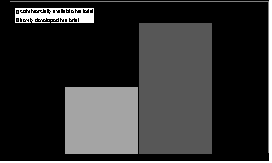
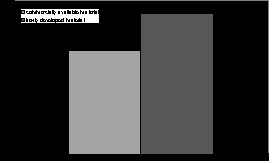
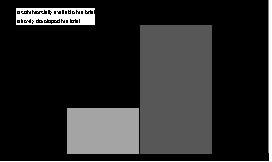
Since the material emphasizes strength as the main material property enhancement, compressive, flexural, and bond strength experiments are performed. The test data are compared with the properties of the popular European fire proof coating material for shotcreting and on site casting. Figures 1, 2 and 3 show experiment results. As shown in Figure 1, 28 day compressive strengths of the newly developed material and the commercially available material are 20.89 MPa and 7.44 MPa, respectively. Also, as shown in Figure 2, the 28 day flexural strengths of the newly developed material and the commercially available material are 4.30 MPa and 2.22 MPa, respectively. Finally, as shown in Figure 3, the bond strengths of the newly developed material and the commercially available material are 1.83 MPa and 1.34 MPa, respectively. The mechanical test results show that the newly developed material has much greater strength capacities than the material available in the market.
3. Testing Procedure
3.1 Production of specimens
Concrete lining specimens are designed based on a general NATM tunnel concrete lining (Tajima et al., 2005). The mix design of concrete of Korean Highway Corporation is used to cast original RC tunnel lining. Table 1 shows mixture design contents of concrete of RC tunnel lining. The expected 28 day compressive strength of concrete is 24 MPa.

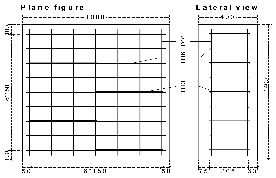
Specimen panel size is 1400 mm×1000 mm×400 mm. D16 and D13 steel bars are used as main reinforcement and hoop reinforcement, respectively. K-type sheathed thermocouples were embedded at specified locations in the tunnel lining specimen to obtain the temperature data. Five thermo couples for fire protection coated specimens and four thermocouples for uncoated concrete tunnel lining specimen are placed at specific locations of specimen to measure temperatures. Thermocouple locations are ① interface between concrete and fire protection material, ② mid-depth of concrete cover thickness (37.5 mm), ③ surface of bottom steel rein-forcing bar (75 mm), ④ mid-depth of specimen (207.5 mm) ⑤ mid-depth of top concrete cover thickness (370 mm). Figures 4 show schematic drawings of reinforcement arrangement of the specimen and sheathed thermocouple locations, respectively.
The newly developed fire protection coating material is applied on the concrete tunnel lining surface. Coating thicknesses of 20 mm, 30 mm and 40 mm were selected to verify the fire protection performance according to the thickness of fire protection coating. First, 1400 mm×1000 mm size of steel wire mesh was attached on the surface to enhance interface bonding. And after 28 days, dry cured specimens were coated with fire protection material by hand. Single specimen was produced for each thickness and single non-coated specimen was tested as a control specimen. Figures 5 is the photo of applying newly developed fire protection material on the specimen. Table 2 shows the test specimens and test variables are the thickness of fire-proofing materials and fire curves.
Table 2. Test specimens | |||
Specimen | Protection Level | Fire Curves | |
RABT | RWS | ||
Control | No protection | ● | |
RABT-20 | 20 mm thick. protection | ● | |
RABT-30 | 30 mm thick. protection | ● | |
RWS-40 | 40 mm thick. protection | ● | |
3.2 Fire loading curve and fire test
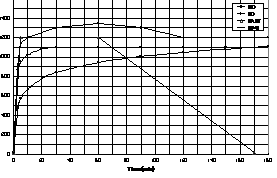
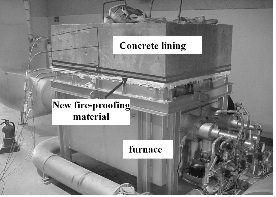
Fire test was carried out after 28 days of dry curing of fire protection material. Fire was applied to the coated face of the specimen. RABT (Maximum peak temperature is 1,200℃) and RWS (Maximum peak temperature is 1,350℃) fire curves were applied and temperatures were recorded from thermocouples. RABT is fire load regulation for road tunnel in Germany and RWS is standard curve of Ministry of Transport in the Netherlands. Figure 6 shows time-temperature curve and Figure 7 shows a photo of specimen setup on furnace.
4.Fire Test Results
4.1 Control Specimen (without Protection)
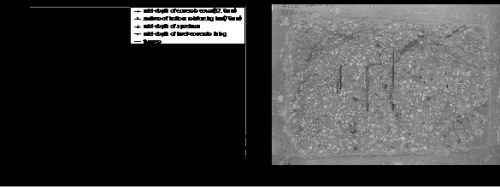
Figures 8 shows measured internal temperature dis-tri-bution and photo of without coated specimen after fire testing. The furnace temperature-time curve is shown for comparison purpose. As shown in Figure 8, when the furnace temperature reaches 1,200℃, temperature at mid depth of concrete cover abruptly increased due to the cover thickness spalling caused by high temperature. About 20 minutes after the start of the test, concrete surrounding the reinforcements also spalled off and temperature of the bottom reinforcement increased rapidly. During the test, water and steam were continuously released from the cracks of the side surfaces of specimen. The cracks were propagated toward the upper part of the specimen at the side surfaces. The highest temperature measured at mid-depth of concrete cover was 1,197℃, and the maximum temperature at surface of bottom reinforcing bar was 1,075℃. Overall, it was observed that concrete lining was severely damaged by spalling and main reinforce-ment bar was exposed.
|
Fig. 8. Measured internal temperature distribution (Left) and Photo of test results (Right)[Control]. |
|
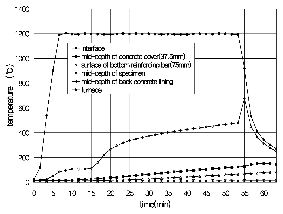
Fig. 9. Measured internal temperature distribution (Left) and Photo of test results (Right)[RABT-20]. |

4.2 RABT-20 Specimen
The newly developed fire protection materials with the thickness of 20 mm were applied to the specimen. Figure 9 shows the time-temperature history within the concrete lining specimen under RABT fire scenario. In the test, it was observed that the fire protection coating exploded abruptly by spalling after 50 minutes from the start of the test. Most of the fire protection coating spalled off and test was stopped for a safety reason. When the test was stopped, temperatures at all thermocouple locations were continuously increasing. The highest temperature at interface was 839℃. The photo shows that concrete lining cover and fire protection material was severely damaged by spalling. In addition, steel wire mesh for strengthening the interface was separated from the specimen.
4.3 RABT-30 Specimen
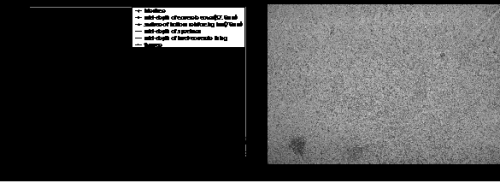
The newly developed fire protection materials with the thickness of 30 mm were applied to the specimen and then it was tested under RABT fire scenario. Figure 10 shows the time-temperature history within the concrete lining specimen during the fire test. The behavior of concrete lining specimen with thickness of 30 mm fire protection coating was stable during the test, and was different from that of the specimen with thickness of 20 mm fire protection coating. After 20 minutes from the start of the test, temperature at interface between concrete lining cover and fire pro-tection coating increased significantly. Significant amount of steam is released from the gaps between thermocouples and specimen during the test, but the amount of steam is less than that observed from the specimen with thickness of 20 mm coating. There were no visible cracks on the specimen surface. The highest temperature measured at interface were 473℃, at mid-depth of concrete cover was 163℃, and at surface of lower reinforcing bar was 129℃. Figure 11 shows the surface of fire protection coating materials after the test and no significant damages except slight color change were found at fire applied surface even under RABT fire loading.
|
Fig. 10. Measured internal temperature distribution (Left) and Photo of test results (Right)[RABT-30]. |
4.4 RWS-40 Specimen
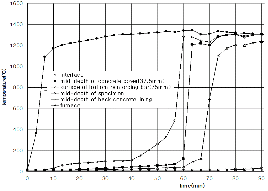
The newly developed fire protection materials with the thickness of 40 mm were applied to the specimen and then it was tested under RWS fire scenario. Because it was possible to get the good fire performance by using 30 mm thickness under RABT fire loading, it was intended that fire-proofing performance when the fire protection thickness is 40 mm should be evaluated under RWS fire scenario. Figure 11 shows the time- temperature history within the concrete lining specimen during the fire test.
The newly developed fire protection material showed good fire performance until 40 minutes elapsed after the starting of the test even under around of 1,300℃. However, after it passed 45 minutes under 1,300℃, this material started to melt after approximately 60 minutes elapsed. The fire protection material as well as the cover concrete was also spalled off and tem-perature of the bottom reinforcement increased rapidly like a specimen without fire-proofing. The cracks on the specimen surface were also quickly propagated toward the upper part of the specimen, and finally this specimen was severely damaged by spalling and main reinforcement bar was also exposed. The highest temperature measured at mid-depth of concrete cover was 1,312℃ at surface of bottom reinforcing bar was 1,247℃. From the RWS test results, it is found that increasing the thickness of the newly developed fire protection material or applying an alternative fire protection material such as shell sand is indispensable to resist severer fire condition such as RWS fire scenario even though the fire protection material showed a good fire-proofing performance below the maximum temperature 1,200℃.

5.Conclusion
Suitable fire protection measures are required for tunnel safety especially when concrete lining is considered as a structural member. From the experimental test results, it was confirmed that the newly developed cementitious material played a key role in protecting concrete under RABT fire loading condition (Maximum peak temperature is 1,200℃). The newly developed fire-proofing material with 30 mm thickness showed good fire protection performance under RABT fire loading.
From the RWS test results, it is found that increasing the thickness of the new material or applying an another component material such as shell sand is indispensable to resist RWS condition even though the new material showed a good fire-proofing performance below the maximum temperature 1,200℃.
But, the addition of bottom ash, which has porous micro structure, improves fire protection ability. Moreover, the usage of industrial wastes from coal generated electric power plant such as bottom ash can reduce the total construction cost.