


1. Introduction
2. Pre-Construction Investigations
3. Investifations During Excavation
4. Methodology for Excavation in Difficult Rock Mass Conditions
5. Case Examples
5.1 Recently completed tunnels
5.2Projects under construction/in planning
6. Concluding Remarks
1. Introduction
Since the early 1980’s around 50 subsea rock tunnels have been built along the coast of Norway. Most of these are road tunnels, with the 7.9 km long Bømlafjord tunnel as the longest, and the Eiksund tunnel as the deepest, with its lowest section 287 m below sea level. Some subsea tunnels have also been built for the oil industry as shore approaches and pipeline tunnels, and some for water supply and sewerage.
Extensive site investigations, with offshore acoustical profiling, refraction seismics and in most cases also core drilling in addition to conventional desk studies and onshore mapping, are always carried out for the subsea tunnels. In addition, extensive investigations during excavation are carried out. In many cases, excavation of the Norwegian subsea tunnels has been completed without major problems related to the ground conditions. In difficult ground conditions, tunnelling challenges have in most cases been tackled efficiently by extensive investigation from the tunnel face and well planned procedures for excavation and rock support. The most difficult rock mass conditions in the Norwegian hard rock subsea tunnels have been represented by major faults/weakness zones with large water inflow.
This paper will discuss the challenges related to identifying zones of adverse rock mass conditions at the investigation stage, and methodology for tunnelling through such ground conditions, based on experience from the Norwegian subsea tunnel projects. For illustration, two relevant, recently completed projects (Atlantic Ocean tunnel and the T-connection) will be discussed in some detail, and two very long and deep subsea tunnels under construction and in planning (Ryfast and Rogfast, respectively) will be briefly described. The paper is based on the author’s experience as members of expert panels for many subsea projects.
2.Pre-Construction Investigations
The main pre-construction investigations for a subsea tunnel are:
1)Desk study
2)Onshore engineering geological mapping
3)Reflection seismics
4)Refraction seismics
5)Core drilling
The desk study includes review of geological maps, reports, aerial photos and experience from any nearby projects, and represents the important first step of the investigations. The desk study is also important for the planning of further investigation of the project area. The onshore mapping includes conventional geological mapping to determine rock types, major geological structures such as faults, dikes, lithological contacts, and any other features that may represent major weakness zones in the planned tunnel area, but has main focus on the following important engineering geological factors:
∙Rock types; character, distribution and strength.
∙Weakness zones/ faults; location, orientation and character. Each zone is evaluated and described individually.
∙Jointing; including orientations of main joint sets, spacings, continuity, roughness and coating/filling (gouge material).
From the collected engineering geological inform-ation an engineering geological model is developed. Samples are taken for laboratory testing of physical and mechanical properties. To avoid the effect of weathering in samples taken in outcrops, some blasting is often necessary.
Reflection seismic investigation (often referred to as acoustic profiling) is used for finding the depths to different geological layers (reflectors), including the depth to the bedrock surface where it is covered by loose deposits. The bedrock may be located below as much as 200m of sediments. The main target for this type of survey is to get an overall view of the soil distribution in the area to produce a map of the rock surface. These maps are of great importance for identifying favourable corridors for subsea tunnel crossing. Refraction seismic results are used for “calibration” of estimated sonic velocities.
Refraction seismic investigation is performed by positioning a cable with hydrophones on the sea bottom and detonating small charges of dynamite. Based on monitoring the arrival time of the refracted waves, the thickness of soil cover and sections of different sonic velocities are identified as illustrated in Fig. 1. Interpretation of seismic velocities and thickness of the various layers is a complex process, and a great deal of operational experience is required for the results presented in a profile to be regarded as reliable.
In addition to the variations of the rocks, the in situ seismic velocities in rock masses depend on:
∙The rock stresses; causing a general increase of seismic velocity with depth. Thus, direct comp-arison of velocities at the surface and at the tunnel level is not realistic.
∙The degree of jointing; representing an important factor in interpretation of refraction seismic measurements to assess the block size.
∙The presence of open joints or joints with filling.
∙The presence of faults and weakness zones
|
Fig. 1. Example illustrating the use of seismic investigation and core drilling for planning of subsea tunnel |
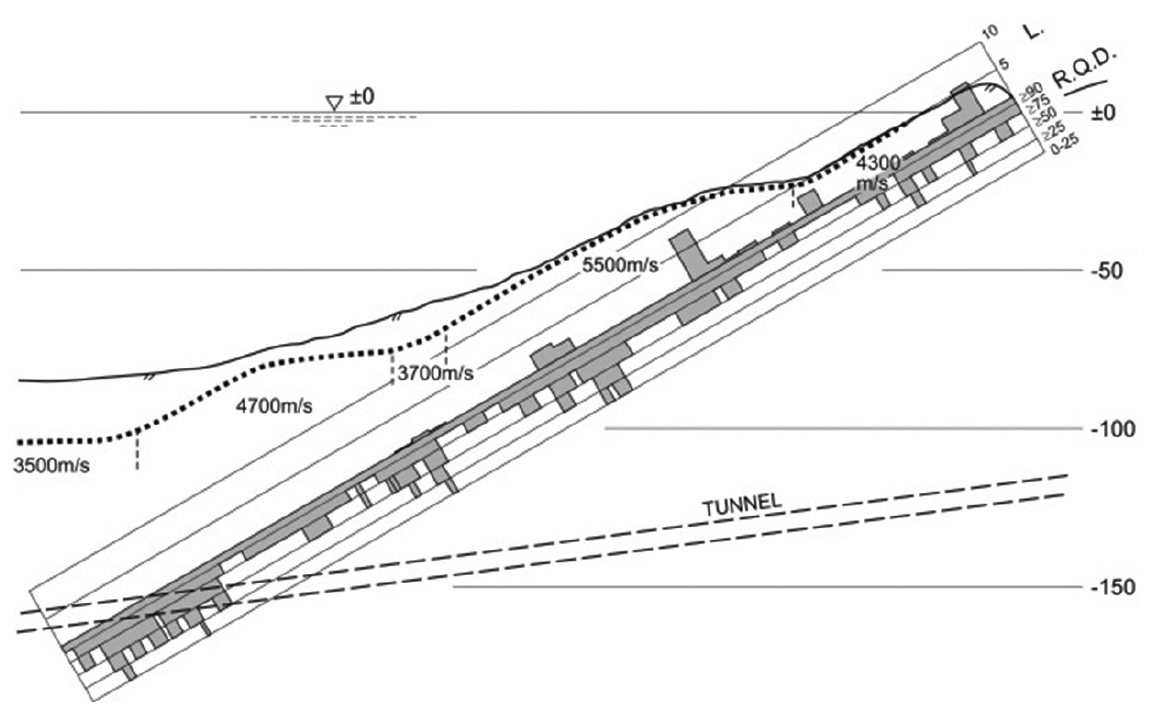
Thus, seismic methods do not automatically give high quality results for all geological environments. Seismic velocities higher than 5,000 m/s generally indicate good quality rock masses below the water table, while the poor quality rock mass of weakness zones have velocities lower than 4,000 m/s. In some cases seismic velocities lower than 2,500 m/s, corresponding to the velocity of moraine, have been monitored for weakness zones.
The dotted line in Fig. 1 represents interpreted rock surface based on the seismic investigations. The velocities of the various sections (3,500-5,500 m/s in rock and about 1,700 m/s in soil) are based on refraction seismics. RQD and Lugeon-values (L) are shown along the core drill hole.
Core drilling is used to obtain geo-information from volumes of rock masses that cannot be observed, and is often used in combination with geophysical measurement as shown in Fig. 1. In most cases for subsea tunnels, core drilling is carried out from the shore as illustrated in the figure, but in some cases it is also carried out as directional drilling. In a few cases, when this has been considered necessary to prove the feasibility of the project, core drilling is also carried out from drill ships.
The purpose of a core drilling investigation is to:
∙Obtain more information on rock mass structure.
∙Study ground water conditions.
∙Provide samples for laboratory testing and petrog-raphic analyses.
∙Confirm the geological interpretation.
∙Obtain information on the rock types and their boundaries in the rock mass.
In hard rocks dominated by discontinuities, core drilling is often carried out to study certain larger faults or weakness zones which are assumed to determine the stability and ground water conditions of the tunnel. The drill holes will, however, also give additional information where they penetrate the adjacent rock masses.
Considering the high cost of good quality core drilling, it is important to spend sufficient time and money for high quality core examination and reporting, including high quality photographs of the cores.
3.Investifations During Excavation
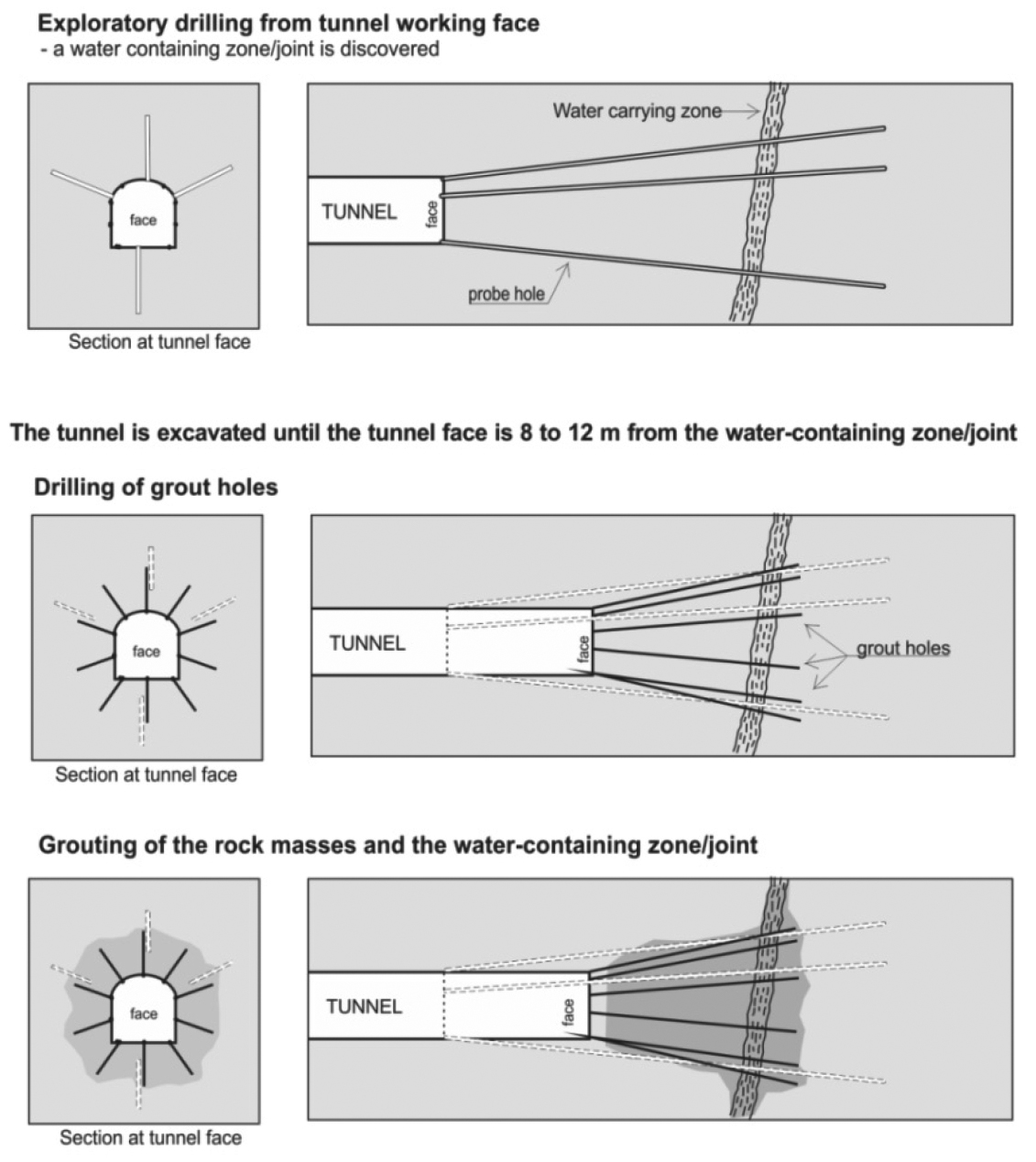
Even the most extensive pre-construction inves-tigations cannot reveal all detail regarding rock conditions. Some uncertainty will always remain when tunnelling starts. To avoid any “unexpected conditions”, and at all times have good control, systematic probe drilling during tunnelling is very important. Probing is normally done as percussive drilling by using the tunnel jumbo. A common number of holes for probe drilling under water are 3-5, and the holes are drilled according to procedures as shown in Fig. 2.
|
Fig. 2. Principles of probe drilling and pre-grouting. Typical length of probe drilling holes is 25-30 m, and the overlap is typically about 5 m (from Nilsen & Palmstrøm, 2013) |
The most difficult rock mass conditions often occur in the fault zones at the deepest part of the tunnel. Any uncontrolled major water inflow here may have severe consequences. In such sections of the tunnel, core drilling is sometimes used for probe drilling.
Probe drilling also has the very important purpose of providing the basis for decision whether to grout or not as described in the next section of this paper.
In addition to probe drilling, continuous follow-up at the tunnel face by well qualified engineering geologists and rock engineers is of great importance. In Norwegian tunnelling this has become more and more realized, and time for such follow up is today included in the contract.
For the more recent projects, MWD (Measurement While Drilling) and DPI (Drill Parameter Interpretation) have been applied for predicting rock mass conditions ahead of the tunnel face. Three main factors describing the rock mass conditions are normally defined by this approach; rock hardness (strength), degree of fracturing and water conditions. The potential of MWD/DPI for estimating rock strength ahead of the face is illustrated by Fig. 3.
|
Fig. 3. MWD/DPI-interpretation of rock hardness for section of the T-connection subsea road tunnel. Dark spots at the inner end represent particularly hard rock (from Moen, 2011) |
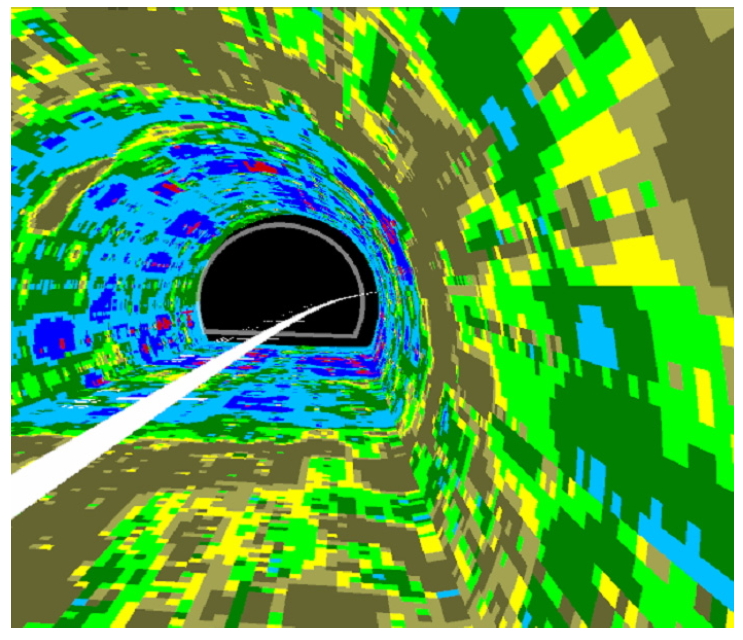
Use of MWD/DPI has a great potential for predicting rock mass conditions ahead of the tunnel face. The method is however still at the development stage, and interpretation of data is often uncertain. As basis for the decision on whether to pre-grout or not, measurement of water inflow in probe drill holes as described above is therefore still the preferred method.
4.Methodology for Excavation in Difficult Rock Mass Conditions
All Norwegian subsea tunnels so far have been excavated by drilling and blasting, which provides great flexibility for varying rock mass conditions and is cost effective. The 6.8 km North Cape tunnel (completed in 1999) was considered for TBM, but also in this case drilling and blasting (D&B) was chosen as the final method. A main reason for not choosing TBM was that the risks connected to potential water inflow were considered too high. During tunnelling, water inflow was not a main problem. The main problem turned out to be thinly bedded rock causing stability problems in the D&B drives, which due to the uniform circular profile and less disturbance of the contour by TBM-excavation probably would have been less in a TBM drive.
Water sealing by pre-grouting is carried out when required according to criteria based on probe drilling. For a Norwegian subsea road tunnel today a maximum inflow of 3 l/min for one probe drill hole and a total of 10 l/min for 4 holes are typical action values for pre-grouting. By applying such criteria, the remaining inflow can be controlled and adapted to preset quantities for economical pumping (normally a maximum of 300 litres/min・km).
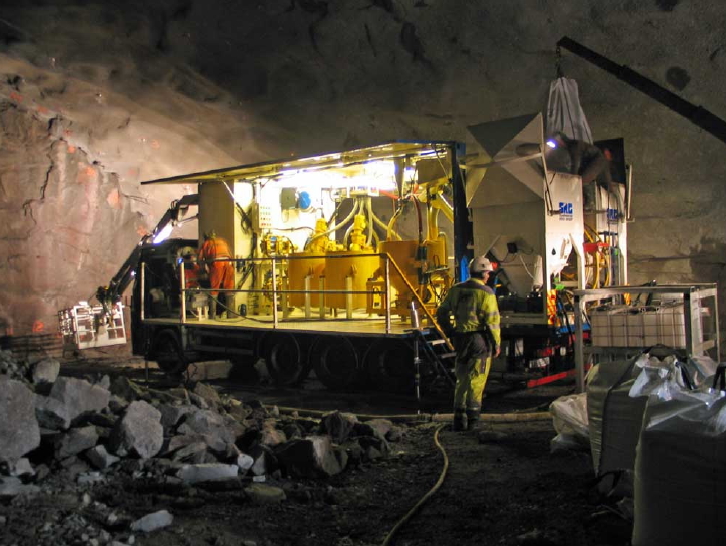
Grouting, when required according to probe drilling, is always carried out as pre-grouting in drillholes typically about 25 m ahead of the face, and with 2 blast rounds overlap. This procedure has been successful even in the deepest of the Norwegian subsea tunnels where grouting against water pressures of 2-3 MPa has been efficiently done with modern packers, pumps and grouting materials. Grouting pressures up to 10 MPa are today quite common with modern grouting rigs as shown in Fig. 4.
For rock support, a combination of fibre reinforced shotcrete and rock bolting is most commonly used. In good quality rock, spot bolting is sometimes considered sufficient, while in poorer quality systematic bolting is most common.
In difficult ground conditions spiling bolts are used, and sometimes also reinforced shotcrete ribs as shown in Fig. 5. When the conditions are particularly challenging, reduced round length (down to 1-2 m instead of the conventional 5 used in good rock) and stepwise excavation of the face are applied. The trend today is that shotcrete ribs (sometimes supplemented with concrete invert) are used in poor rock conditions instead of concrete lining.
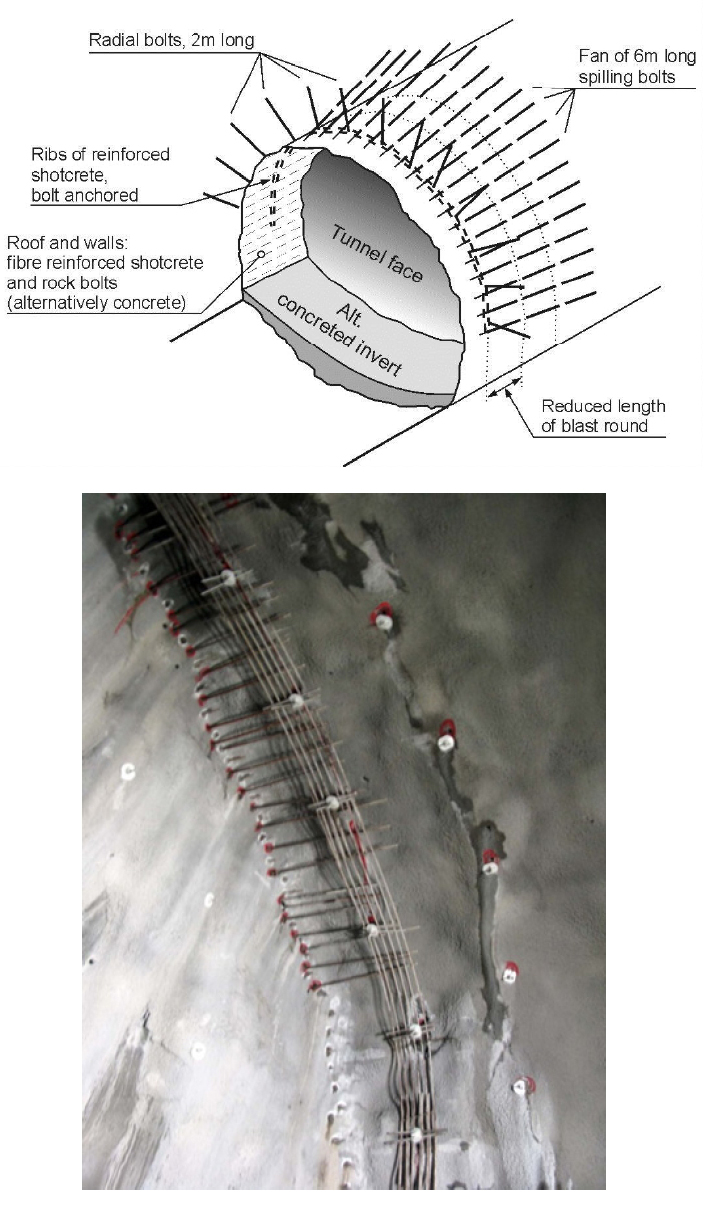
All rock support structures are drained, whether they are made of cast-in-place concrete lining, shotcrete ribs or shotcrete/rock bolting. Shotcrete in subsea tunnels today is most commonly applied as minimum 8 cm thick, wet mix, polypropylene (PP) fibre reinforced.
Rock bolts have extensive corrosion protection. The preferred bolt type is the CT-bolt, which provides multiple corrosion protection by hot-dip galvanizing, epoxy coating and cement grouting applied on both sides of a plastic sleeve, and thus provides excellent corrosion protection for the subsea sections.
5. Case Examples
5.1 Recently completed tunnels
To illustrate the very challenging rock mass conditions that may in some cases be encountered in subsea tunneling, and the way the problems may be solved, two relevant, recent cases will be briefly discussed; the T-connection and the Atlantic Ocean tunnel.

The T-connection
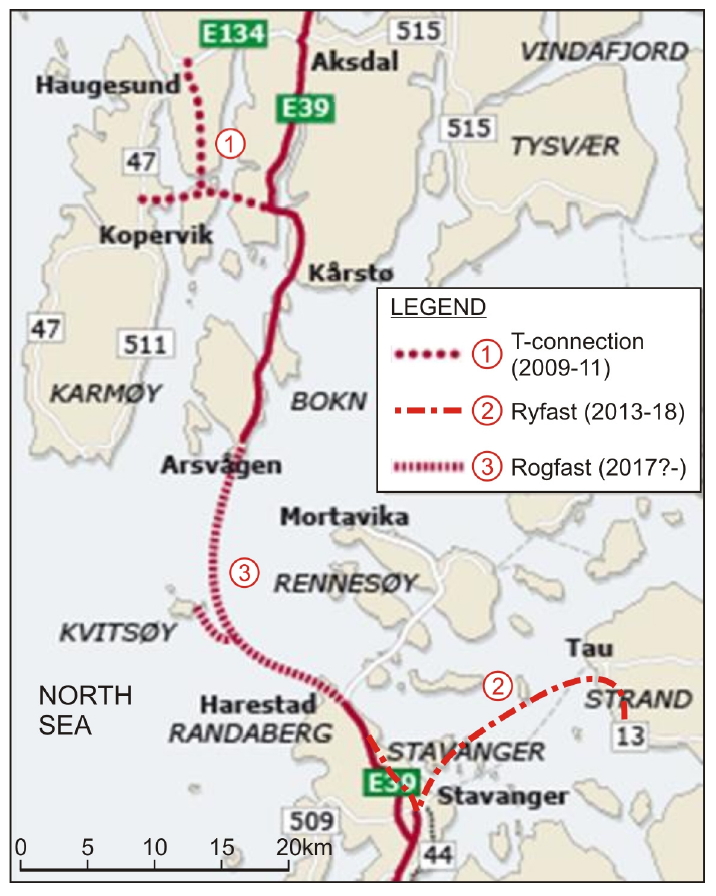
The “T-connection” represents a part of the road connection between Haugesund and Stavanger on the SW coast of Norway as shown in Fig. 8. The tunnel system consists of 2 main tunnels: the 3.4 km long Karmsund tunnel and the 3.8 km long Fördesfjord tunnel, and in addition a 1.2 km long tunnel branch, (see Fig. 6). The main tunnels have a span of 9.5 m with 70 m2 cross sectional area (profile T 9.5). A large roundabout in rock is excavated at the junction between the three tunnels. The deepest points in the two main tunnels are 139 m and 136 m and the slope is 5.5 % to 7.5 %. The tunnels were excavated in 2009-2011, and the project opened for traffic in 2013.
Early in the 1980s, tunnels for a gas pipeline (Statpipe) were excavated parallel with the T-connection tunnels only about approx. 1 km further to the south. The experience from excavation and results from the investigations performed for these gas pipeline tunnels provided very valuable information for planning of the T-connection, especially for the deepest sections with expected very poor and problematic ground conditions as indicated in Fig. 6.
Because of the very difficult ground conditions encountered in the Statpipe tunnels, and since no core drilling was carried out at the pre-construction stage for the T-connection, exploratory drilling ahead of the tunnel face was performed for almost all the tunnel length. No significant water inflows were encountered, and the extent of pre-grouting therefore was moderate and focused on sealing minor inflows.
As shown in Fig. 6, the T-connection tunnels were excavated in greenstone/greenschist, sandstone, phyllite and gneiss. The degree of jointing was mainly moderate. There were, however, many small weakness zones (fault and shears) and a few large. Still, the T-connection tunnels did not encounter quite as problematic rocks as the existing gas pipeline tunnel.
Two large weakness zones (thickest steep lines in the profile in Fig. 6) represented the most problematic tunnelling conditions. Here, the blast round length was reduced from 5 to 3.5 m, and 6-8 m long spiling bolts with 3 m overlap were installed in roof and walls before blasting. Thick fibre reinforced shotcrete with rebar reinforced arches and rock bolts were used for temporary and permanent support.
Atlantic Ocean tunnel
The Atlantic Ocean tunnel, located on the central west coast of Norway, is 5.7 km long and has an excavated cross section of approx. 85 m2. The tunnel was opened for traffic in 2009. A longitudinal profile along the tunnel is shown in Fig. 7.
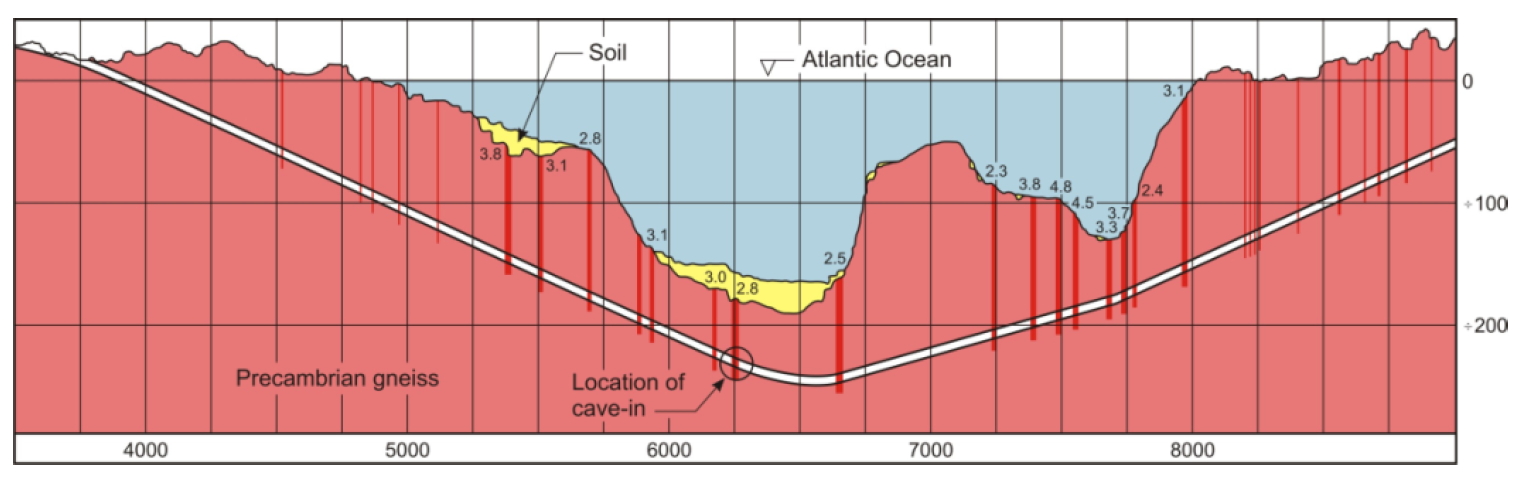
The bedrock is Precambrian granitic gneiss of mainly good quality. The conventional pre-construction investigations for this type of project were carried out, including reflection and refraction seismic investigations. Based on the latter, several low velocity zones, representing faults/ weakness zones under water were detected. Near the bottom of the planned tunnel zones with seismic velocities as low as 2,500 and 2,800 m/s were identified as shown in Fig. 7. Based on overall evaluation of the rock mass conditions, a minimum rock cover of 45 m was chosen, but it was realized that several of the low velocity zones under sea might be quite challenging, and this was taken into account in the planning of excavation and rock support.
Before entering a major zone at Station 6242, several nearby fault zones with seismic velocity down to 2.8-3.1 km/s, and even down to 2.4 km/s from the other side, had been crossed without major problems. These zones contained crushed rock and clay gouge, but very little water. Probe drilling indicated poor quality rock in the 2.8 km/s zone at Sta. 6242, but little water inflow. Thus, similar rock mass conditions as in the previous faults/weakness zones were expected. As extra precaution, the great water depth and limited rock cover taken into consideration, grouting was carried out in order to seal the joints and possibly also stabilize the zone material, and after that excavation was started with reduced round length (3 m), shotcreting, systematic radial bolting and installation of 6 m long spiling bolts.
The weakness zone proved to be of very poor quality, and after blasting the reduced round length there was a tendency of small rock fragments falling down between the spiling bolts. Attempts to stop this by applying shotcrete were unsuccessful, and after a few hours a 5-6 m high cave-in of the roof had developed, covering the full tunnel width and the 3 m round length. Based on holes drilled later it was found likely that the cave in progressed about 10 m above the tunnel roof.
In order to stabilize the tunnel, excavated material had to be filled up against the tunnel face and a more than 10 m long concrete plug was established to seal the tunnel. Probe drilling indicated considerable water leakage, and extensive grouting of the backfill material and the surrounding rock past the slide scar was required. Based on careful excavation with reduced round lengths, shotcreting/radial bolting and spiling with drillable rock bolts the tunnel face was re-established after 5.5 weeks at the same position as it was before the cave-in. Core drilling through the weakness zone showed that it was more than 25 m wide and had considerable water leakage.
|
Fig. 8. Locations of the T-connection project (completed), Ryfast (under construction) and Rogfast (in planning) |
Further tunnelling was based on a procedure including continuous pre-grouting, spiling, excavation with reduced round lengths/piece by piece, shotcreting/ radial bolting and installation of reinforced shotcrete arches. The process was very time consuming due to extensive water leakages (up to 500 l/min in one single drill hole) at very high pressure (up to 23 bar). Tunnelling was continued approx. 20 m from the west side, and this position was reached about 10 months after the date of the cave in. The rest of the fault zone was excavated from the east side based on a similar procedure as described above.
More than 1000 tons of grout (mainly micro cement, but also standard cement and polyurethane) was needed to seal the leakages of the approximately 25 m wide fault/weakness zone. After completion of the tunnel in December 2009, the total leakage was only 500 l/min (or 88 l/min per km tunnel), which can be characterized as quite low for this type of tunnels.
5.2Projects under construction/in planning
Several new, very long and deep subsea tunnel projects will be built in the near future, including the Ryfast and Rogfast projects. These are located only about 30 and 20 km, respectively, south of the T-connection project, see Fig. 8.
Ryfast includes two tunnels: the Solbakk tunnel and the Hundvåg tunnel, both with two tubes 12 m apart. Each tube will have a span of 9 m (70 m2 cross section) and cross passages for every 250 m. The Solbakk tunnel will be 14 km long, and descend down to -290 m below sea level. It will pass through various gneisses, and several large weakness zones are expected. The Hundvåg tunnel will be 5.5 km long, with phyllites at the southern part, and gneiss in the rest. Construction started in 2013 and planned opening of the link is in 2019.
The tunnels are excavated by drill and blast. Difficult rock mass are to be expected for sections of the tunnel. It is estimated that 250,000 rock bolts and 100,000 m3 of shotcrete will be used for rock support, plus cast in place concrete lining in very poor ground conditions. The cost for the project is estimated at 5,500 mill. NOK.
Rogfast, which is still at the pre-construction investigation stage, is also planned with two separate tubes, each with two lanes. Each tube will be about 26.7 km long and go down to a deepest level of about 385 m below sea level. The project is planned with connection approximately midway to the island Kvitsøy. The structural geology of the project area is very complex, with several major faults and thrust zones, and with phyllite as predominant rock type in south, gabbro and greenstone in the middle and gneiss in north. Ground investigation is particularly challenging because of the long sections under open, deep sea.
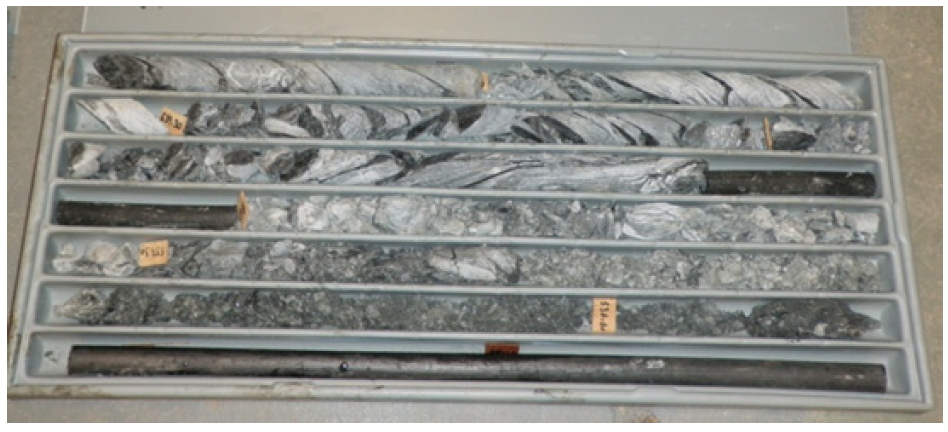
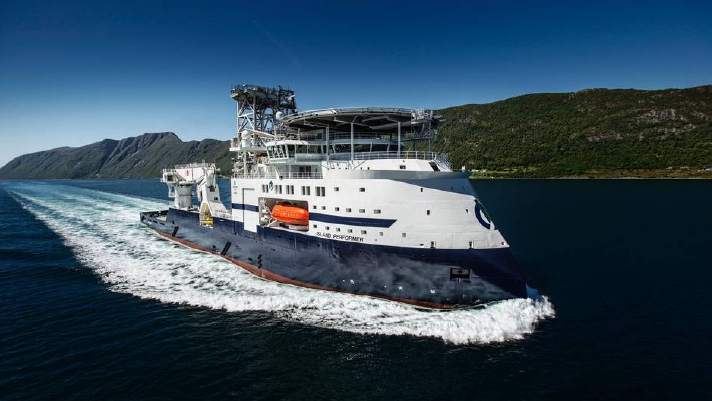
The conditions are expected to be very challenging for Rogfast, with several poor quality weakness zones as illustrated by the drill cores in Fig. 9. Extensive investigations have been done already, including core drilling from drill ships at sea depths of up to 290 m, see Fig. 10. The cost of the Rogfast project is estimated at 10,200 mill. NOK, and earliest start of construction is estimated to 2017.
6. Concluding Remarks
This review of Norwegian projects illustrates that for subsea tunnels, even in hard rock, very challenging conditions are often encountered. The most difficult conditions are represented by major faults and weakness zones, particularly when very poor rock mass quality is combined with high water inflow. Even in such cases, the Norwegian projects have however demon-strated that with the technologies regarding pre- grouting, tunnelling and rock support which are available today, such challenges may be successfully coped with.
For any subsea tunnel project extensive, well planned and professionally performed pre-construction investigations, continuous investigations during tunnelling, appropriate procedures for excavation/rock support and high state of readiness are crucial. This applies even more for very challenging subsea tunnel projects like Rogfast, which isplanned to be built in the near future on the southwest coast of Norway. The long experience from the many completed subsea tunnels in Norway, and particularly the lessons learned from projects such as the T-connection and others, undoubtedly will have a great value for the planning and safe completion of this project.