

1.Introduction
2. Stability Equations
3.Differential Quadrature Method (DQM)
4.Applications of DQM
5.Numerical Studies and Comparisons
6.Conclusions
1.Introduction
Curved beams have been used frequently in highway bridge structures. The construction time is a factor of immense importance in the selection of a suitable structural system where the construction site needs to be used for other operations during the construction period (Kang and Yoo1)).
The common engineering theory of flexure is based on the Bernoulli-Euler-Navier assumption that cross sections perpendicular to the centroid before bending remain plane and perpendicular to the deformed locus. In contrast, torsion was considered to be completely defined by the theory of Saint-Venant. A crucial point in the Saint-Venant theory is that warping deformations can occur freely and uniformly throughout the beam. Ojalvo et al.2) studied the elastic stability of ring segments with a thrust or a pull directed along the chord neglecting the warping effect. The studies on the stability analysis of curved beams were initiated by Timoshenko and Gere3) and Vlasov4). Timoshenko and Gere3) obtained closed-form solutions for the elastic buckling of a simply supported arch of narrow rectangular cross section under the action of equal and opposite end moments and of a pin-ended arch subjected to a uniformly distributed radial load. Vlasov4) extended this to arches of monosymmetric I-section. For narrow rectangular beams, his solutions for the elastic critical moment of a doubly symmetric I-section arch under uniform bending reduces to the solution of Timoshenko and Gere3). Papangelis and Trahair5) conducted a theoretical study of the flexural-torsional buckling of doubly symmetric arches to confirm the predictions of Timoshenko and Gere3) for beams in uniform compression and of Vlasov4) for beams in uniform bending. Yoo and Pfeiffer6) obtained the solutions for the buckling of arches under more general loading conditions by computer methods. Trahair and Papangelis7) also developed an out-of-plane buckling theory for beams of monosymmetric cross-section using the second variation of the total potential. Yang and Kuo8) studied the static stability of curved thin- walled beams using the principle of virtual dis-placements in a Lagrangian formulation with emphasis placed on the effect of curvature, and they presented closed-form solutions for arches in uniform bending and uniform compression. Kang and Yoo9) solved the buckling loads of two hypothetical arches based on the stability equations. Recently, Han and Kang10) studied the out-of- plane buckling of curved beams without warping using the differential quadrature method (DQM), and Kang11) applied the method to the analysis of out-of-plane buckling analysis of curved beams subjected to in-plane bending moments with warping using DQM.
Owing to their importance in many fields of technology and engineering, the stability behavior of elastic curved beams has been the subject of a large number of investigations. Despite of a number of advantages, a curved member behaves in an extremely complex manner as compared to a straight member, and practicing engineers have often been discouraged by the complexity because of the initial curvature. However, the mathematical difficulties associated with curved members have been largely over-come with the application of digital computers and the development of numerical methods. Solutions of the relevant differential equations have traditionally been obtained by the standard finite difference or finite element methods. These techniques require a great deal of computer time as the number of discrete nodes becomes relatively large under conditions of complex geometry and loading. In a large number of cases, the moderately accurate solution which can be calculated rapidly is desired at only a few points in the physical domain. However, in order to get results with even only limited accuracy at or near a point of interest for a reasonably complicated problem, solutions often have dependence of the accuracy and stability of the mentioned methods on the nature and refinement of the discretization of the domain. In the present work, the differential quadrature method, introduced by Bellman and Casti12), is used to analyze the out-of-plane stability of a single-span wide-flame curved beam including a warping contribution. Critical values for the circumferential force are calculated for the member subjected to a uniformly distributed radial load. The member has both ends either simply supported or clamped, or has clamped-simply supported ends. The results are compared with previous theoretical results. For  the general cases of loading conditions and boundary conditions, it is very difficult to obtain closed-form solutions for buckling loads of curved beams because of the coupling effect of stress resultants and displacements, which results in a system of coupled differential equations with variable coefficients. This approach can be used for applying the curved steel rib in tunnels.
2. Stability Equations
It should be mentioned that there has been a considerable controversy and disagreement among various investigators as to which theory most accurately depicts the flexural torsional buckling behavior of curved beams. In this paper, we are not concerned with the disagreement in the governing equations, but rather with the in-troduction of a new numerical method for solution of the equations.
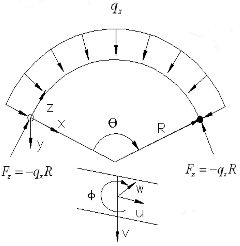
The differential equations governing the member subjected to uniformly distributed radial load qx can be written as (Yang and Kuo8))

 (1)
(1)

 (2)
(2)
where each prime denotes one differ-entiation with respect to the dimensionless
distance coordinate  , in which
  is the
opening angle of the member, and  is the angle
from left support to generic point.  ,
,  ,
,  ,
,
 ,
,  ,
,  ,
,  ,
,  , and
, and  are the modulus of elasticity, the shear modulus, the moment of
inertia about the  -axis (see Figure 1), the
warping constant, the Saint-Venant torsion constant, the polar radius of gyration, the cross-sectional area, the displacement of the shear center in the  -direction, and the angle of twist of arch cross-section, respectively. Fz is the circumferential force (some authors use axial force', see Figure 1) due to qx.
This force will be constant if the end conditions are simply supported and is given by
 (3)
(3)
The following boundary conditions are taken for simply supported ends (Tan and Shore13)): ((a) no out-of-plane deflection; (b) no torsional rotation; (c) no bending moment; and (d) no bimoment. The bending moment and the bimoment of the member can written as
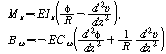 (4)
(4)
For clamped ends,  and
and  equal zero where
  represents the warping as defined by Vlasov4). It can be written as (Chaudhuri and Shore14))
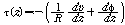 (5)
(5)
The following boundary conditions are taken for simply supported ends.
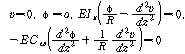 (6)
(6)
For clamped ends, the boundary conditions can be written as
 (7)
(7)
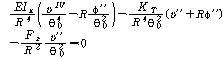
The differential equations governing the member subjected to uniformly distributed radial load qx neglecting warping can be written as ; see Han and Kang10).
 (8)
(8)
 (9)
(9)
3.Differential Quadrature Method (DQM)
The DQM was introduced by Bellman and Casti12). By formulating the quadrature rule for a derivative as an analogous extension of quadrature for integrals in their introductory paper, they proposed the differential quadrature method as a new technique for the numerical solution of initial value problems of ordinary and partial differential equations. The differential quadrature technique approximates the derivative of a function with respect to a space variable at a given discrete point as a weighted linear sum of the function values at all discrete points in the domain of that variable. This is in contrast to the finite difference method in which a solution value at a point is a function of values at adjacent points only. Even if the finite difference method is of high order enough to cover all points on the grid, a fundamental difference remains in that the method of differential quadrature is a polynomial fitting while the higher-order finite difference method is a Taylor series expansion.
From a mathematical point of view, the application of the differential quadrature method to a partial differential equation can be expressed as follows:
 for
for (10)
(10)
where L denotes a differential operator, are the discrete points considered in the domain,
  are the row vectors of the
  values,
  are the function values at these points,
 are the weighting coefficients attached to these function values, and N denotes the number of discrete points in the domain. This equation, thus, can be expressed as the derivatives of a function at a discrete point in terms of the function values at all discrete points in the variable domain.
The general form of the function  is taken as
 for
for  (11)
(11)
If the differential operator L represents an  derivative, then
 for
for
 (12)
(12)
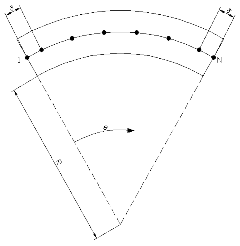
This expression represents N sets of N linear algebraic equations, giving a unique solution for the weighting coefficients,  , since the coefficient matrix is a Vandermonde matrix which always has an inverse, as described by Hamming15). Thus, the weighting coefficients are then used in the equations to express the derivatives of a function at a discrete point in terms of the function values at all discrete points in the variable domain. Multidimensional problems in more than one space variable can be treated in essentially the same way by using linear transformations with respect to the space variables for the derivatives. The method is limited with increasing number of grid points. The accuracy of the quadrature solutions is dictated by the choice of sampling points and by the accuracy of the weighting coefficients. Equally space grid points, due to their obvious convenience, have been in use by most investigators. Before solving these equations, one invokes the boundary conditions replacing the boundary- point equations by the DQM equations of the boundary conditions. The quadrature analog of the two conditions at a boundary are written for the boundary points and their adjacent
  - points. The quadrature grid of a domain with the adjacent
  -points is shown in Figure 2. In the quadrature equations of the boundary cond-itions, the weighting coefficients should be the ones associated with the boundary points. The necessity of having the adjacent points close to the boundary points arises in problems where the boundary point values of the function are eliminated. This is actually the case with eigenvalue problems in which elimination of the function values away from the boundary may lead to erroneous eigenvectors and eigenvalues even though the eigenvalue solution may have converged. The first step would be to discretize the domain and the boundary. At each point in the domain, the differential quadrature form of the equation of motion has to be satisfied. This set of equations together with the app-ropriate boundary conditions give a total of N number of linear homogeneous simultaneous equations. These equations can be partitioned to correspond to the inner domain points and the boundary points, giving
 (13)
(13)
The submatrices  and
and  are weighting coefficients submatrices. It is important to note that the elements of the three matrices
  and
and  are scalar con-stants but only the diagonal elements of the submatrix
  will be functions of the eig-envalue. The vectors {
 } and {
 } are the dimensionless normal deflection vectors corre-sponding to the boundary points and the inner domain points, respectively.
Using forward elimination process, one can express in the form of a general eigenvalue problem and solve for the buckling of the member.
It was applied for the first time to static analysis of structural components by Jang et al.16). The versatility of the DQM to engineering analysis in general and to structural analysis in particular is becoming increasingly evident by the related publications of recent years. Kukreti et al.17) calculated the fundamental frequencies of tapered plates, and Farsa et al.18) applied the method to analysis and detailed parametric evaluation of the fundamental frequencies of general anisotropic and laminated plates. In another development, the quadrature method was introduced in lubrication mechanics by Malik and Bert19). Recently, Kang11) studied out- of-plane buckling analysis of curved beams subjected to in-plane bending moments with warping using DQM, and Lee et al.20) also studied free vibration analysis of compressive tapered members resting on elastic foundation using differential quadrature method and showed quite agreed with those in the open literature.
4.Applications of DQM
Here DQM is applied to the out-of-plane buckling analysis of curved beams. The differential quadrature approximations governing the beam subjected to uniformly distributed radial loads qx and the boundary conditions are shown.
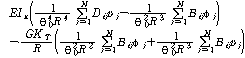
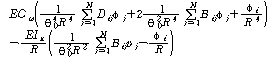
Applying the differential quadrature equation (12) to equations (1) and (2) gives

 (14)
(14)

 (15)
(15)
where  and
and  are the weighting coefficients for the second and fourth-order derivatives, respectively, along the dimensionless axis.
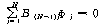
The boundary conditions for both ends simply supported, given by equation (6), can be expressed in differential quadrature form using equation (12).
 at X = 0 (16)
 at X = 0 (17)
 at
at  (18)
(18)
 at
at  (19)
(19)
 at
at  (20)
(20)
 at
at  (21)
(21)
where  denotes a small distance measured along the dimensionless axis from the boundary ends. In their work on the applications of DQM to the static analysis of beams and plates, Jang et al.16) proposed the so-called
  -technique wherein adjacent to the boundary points of the differential quadrature grid, points are chosen at a small distance (in dimensionless value). This
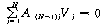
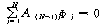
  approach is used to apply more than one boundary conditions for clamped ends, given by equation (7), can also be expressed in differential quadrature form as
 at
at  (22)
(22)
 at
at  (23)
(23)
 at
at  (24)
(24)
 at
at  (25)
(25)
 at
at  (26)
(26)
 at
at  (27)
(27)
 at
at  (28)
(28)
 at
at  (29)
(29)
where  are the weighting coefficients for the first-order derivative.
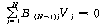
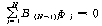
Similarly, the boundary conditions for one clamped end, given by equation (7), and one simply supported end, given by equation (6), can be expressed in differential quadrature form as
 at
at  (30)
(30)
 at
at  (31)
(31)
 at
at  (32)
(32)
 at
at  (33)
(33)
 at
at  (34)
(34)
 at
at  (35)
(35)
 at
at  (36)
(36)
 at
at  (37)
(37)
Mixed boundaries can be easily accommodated by combining these equations; simply change the weighting coefficients. While most analytical methods use the rather laborious technique of superposition to arrive at solutions for mixed boundary problems, this approach of breaking the problem into several easy subproblems is not required in DQM.
5.Numerical Studies and Comparisons
The critical circumferential forces (=Fzcr) of curved beams subjected to distributed radial loads are calculated by the differential quadrature method using equation (13) and are presented together with existing exact solutions. The critical values are evaluated for the case of a single- span, wide-flange curved beams with various end conditions and opening angles.
For comparative studies, the following examples are considered here; a constant length of 10.24 m, a variety of opening angles ranging from  and
and  ,
,  = 92.9
  ,
,  = 11,360
  ,
,  =
=
3870  ,
,  = 555900
  ,
,  = 58.9
  ,
,  = 12.81
  ,
,  = 200.
 ,
,  = 77.2
  ,
,
and dimensionless buckling parameter or critical
circumferential force parameter, 
for neglecting warping.
The results of convergence studies relative to the number of grid points  and the
  para-meter show the accuracy and the sensitivity of the numerical solutions, respectively. The accuracy of the numerical solutions increases with in-creasing
  . Then numerical instabilities arise if
  becomes too large (possibly greater than approx.19); see Kang11)). The sensitivity of the numerical solutions to the choice of optimal value for
  is found to be
  to
to  , which is obtained from trial-and-error calcu-lations. The solution accuracy decreases due to numerical instabilities if
  becomes too big (possibly greater than approx.
  for this case); see Kang11)). The numerical results are computed with 11 discrete points along the dimensionless X-axis and
  .
.
Yang and Kuo8) determined the critical values for the circumferential force of the member. In Table 1, the critical circumferential forces deter-mined by the differential quadrature method are compared with the exact solution by Yang and Kuo8) for the case of simply supported ends. Table 2 shows the numerical results by the DQM for the case of both ends clamped and clamped- simply supported ends without comparison since no data are available. In Table 3, the critical circumferential forces determined by the DQM are compared with the solution by Yang and Kuo8) for the case of simply supported ends neglecting warping (Cw = 0). Table 4 shows that critical circumferential force parameters (=
 ) determined by the DQM are
compared with the solution by Timoshenko and Gere3) for the case of simply supported ends neglecting warping contribution; see Han and Kang10). Table 5 shows critical circumferential force parameter neglecting warping determined by the DQM for the case of both ends clamped and clamped-simply supported ends without comparison since no data are available. In Table 6, critical circumferential force parameter are also compared with the solution by Timoshenko and Gere3) for the case of simply supported ends neglecting warping contribution in the case of  and various stiffness parameters since some data are not available. From Tables 1 and 2, it is seen that the critical loads of the member with clamped ends are much higher than those of the member with simply supported ends and those of the member with mixed clamped- simply supported ends. From Tables 1 and 3, it is observed that the critical loads of the member with warping are much higher than those of the member without warping, and thus warping can have a significant effect on the critical loads. From Tables 4 and 5, it is seen that the critical loads of the member with clamped ends are also much higher than those of the member with simply supported ends and those of the member with mixed clamped-simply supported ends in the case of neglecting warping. Table 6 shows that the critical circumferential force parameter can be increased by increasing the stiffness parameter. The results by DQM also show that the case of both ends simply supported is more affected by the warping than any other boundary conditions, and as the torsion constant of a beam cross-section becomes smaller, the warping stiffness of the cross-section becomes more significant; see Kang11). The critical loads can be increased by decreasing the opening angle
 . As can be seen, the numerical results by the differential quadrature method show excellent agreement with the exact solutions, and critical loads with warping are found to be significant in each case. There is still considerable contro-versy and disagreement among various investi-gators (Kang and Yoo8)) as to which theory most accurately depicts the flexural torsional buckling behavior of curved beams. In this paper, the results of the new numerical method give good accuracy and stability compared with previous theoretical results.
 (degree)
 (degree)
 (degree)
 ,flexural-torsional buckling of beams with both ends simply supported neglecting warping.
 (degree)

 , flexural-torsional buckling of beams with both ends clamped and clamped-simply supported neglecting warping;
  = 1.0
= 1.0
 (degrees)
 (DQM)
(DQM)
 , flexural-torsional buckling of beams with both ends simply supported neglecting warping;


6.Conclusions
The differential quadrature method (DQM) was used to compute the eigenvalues of flexural- torsional buckling of curved beams subjected to uniformly distributed radial loads including a warping deformation. Critical loads with warping, which were found to be significant, were calculated for a single-span wide-flange beam with various end conditions and opening angles. Critical cir-cumferential force parameters were also calculated with various end conditions, opening angles, and stiffness parameters for the case of neglecting warping. Results were compared with the existing exact method where available. New results are given for the boundary conditions which are not considered by previous investigators: clamped- clamped and clamped-simply supported ends. The critical bending moments determined by the DQM were also compared with those by the FEM for flexural-torsional buckling of curved beams subjected to equal and opposite in-plane bending moments including a warping deformation; see Kang11) for more details. The results showed that the numerical results by the DQM using eight discrete points are much more accurate than those by the FEM using eight elements and more accurate than those by the FEM using twenty elements. Only eight discrete points were used for the DQM to get the exact solution for the case. As can be seen, the differential quadrature method (DQM) gives excellent results for the cases treated while requiring only a limited number of grid points: only eleven discrete points were used for the evaluation, and gives good accuracy compared with previous theoretical results.
Notation
The following symbols are used in this paper:
 = cross-sectional area
 = weighting coefficients for the first- order derivative
 ,
, = weighting coefficients for the second and fourth-order derivatives
 = bimoment
 = warping constant
 = modulus of elasticity
Fzcr = critical circumferential force
Fz = circumferential force due to qx
 (critical circumferential force
parameter)
 = function value at point
 = shear modulus
 = moment of inertia about the
  -axis
-axis
 = row vector of
  value
value
 = Saint-Venant torsion constant
L = differential operator
 = bending moment
N = number of discrete points
qx = uniformly distributed radial load
 = polar radius of gyration
 = displacement of shear center in the
  -direction
 = weighting coefficients attached to function value
 dimensionless distance coordinate
 = discrete points in domain
 = small distance measured along dimensionless axis
 = angle from left support to generic point
 = opening angle
 = warping
 = angle of twist