

1. Introduction
2. Rock TBMs development and classification
3. Rock TBM selection
4. Limiting geological conditions for the application of TBMs
4.1 Borability limits
4.2 Instability of the excavation walls
4.3 Instability of the excavation face
4.4 Crossing fault zones
4.5 Tunnels in squeezing ground
5. Conclusions
1. Introduction
The history of rock TBM began and developed with the history of long tunnels, starting at the beginning of the XIX century, when the development of the industrial civilisation led to the development and the acceleration of ground transport of goods and people by rail (Pelizza, 1999b). It was therefore necessary to build new and more convenient transport routes: in Europe the crossing of the Alpine mountain range was the first obstacle to be overcome. This became possible thanks to the construction of long tunnels: the first was that of the Mount Cenis railway tunnel (also known as the Frejus tunnel), which is 12.233m long and was built between 1857 and 1871, and for which the Belgian engineer Henry Maus, specifically entrusted by the government of the Sardinian- Piedmontese Reign, in 1848 planned, built and experimented the first rock-tunnelling machine which was never actually used for the construction of the tunnel (Innaurato and Pelizza, 1968).
Many thousands of kilometers of tunnels have been built since then in the last 150 years and during the next decades, many thousands of kilometres of transportation and of water conveyance tunnels will be excavated to cross straits, or mountain ranges, or even urban areas.
Many of these tunnels will be longer and deeper than those of today and their construction will have to face difficult geotechnical conditions (Hartley 1996).
In long tunnels and/or in difficult geotechnical conditions as exist in many urban areas, the use of TBM is imperative to reduce excavation time and to increase the safety of the working site and environment.
The interest in the full-face boring machines is great, because of the advantages they offer:
∙the work site has better safety conditions;
∙work is easier for the workers;
∙“true” miners are no longer required;
∙the “tunnel”, as an industrial product, is of better quality;
∙the rate of performance, in terms of excavated tunnel, is high;
∙construction time and cost are (or should be) guaranteed.
Without forgetting that one of the main problems for long and deep tunnels is the application of TBM under difficult geotechnical conditions.
Right from the beginning of its earliest applications, the technology of mechanised full-face tunnel excavation has always had to face the limits imposed by the local geology, the economic challenges and schedule competitions of the drill and blast technique and other so-called traditional excavation methods.
The development of TBM has progressed in two directions:
∙the boring of tunnels in massive, hard and abrasive rock;
∙the boring of tunnels in stable, competent rock as well as in ground so unstable that the tunnel has to be lined concurrently to the excavation.
The practically infinite number of combinations of rock, soil and environmental conditions which may be encountered during tunnel excavation has provoked a great difference in the types and characteristics of the available TBM.
TBMs have, for some time now, been divided into the following two main categories:
∙TBM for tunnel excavation in rock formations: usually used to bore long tunnels in rock of medium to high strength with moderate to large overburden and in good stability condition. The basic problem faced by this type of machine is that of how to break down the rock;
∙TBM for tunnelling in so-called loose ground: normally used to excavate tunnels of limited length in basically homogeneous, loose ground and, often, under a groundwater table of limited pressure.
The basic problem faced by this kind of machine is that of the stability of the cavity and of the excavation face.
There are many different schemes for the classification of tunnelling machines throughout the world (DAUB 1997) and these depend on the purpose of the classification.
The AITES/ITA Working Group No. 14 (Mechanisation of excavation) is currently working on the definition of an internationally acceptable classification of TBMs with the purpose of also establishing a univocal terminology set and “guidelines” for the optimum choice of the machine.
2. Rock TBMs development and classification
During the 1846-1930 period, close to 100 rock or hard-ground tunnelling machines of various types were designed and patented, according to the Maus idea, but the actual machines did not, in many cases, actually reach the light of day.
Many of the ingenious devices and/or engineering principles designed or attempted by those early engineers have either been ignored or forgotten. Others can be seen incorporated in the modern tunnelling machines of today.
By the end of the 1920s, after the repeated failures which had attended the introduction of most rock-tunnelling machines, interest in their development tended to wane.
Only in 1952-53 period, the American company, James S. Robbins and Associates, designed and manufactured the “Mittry Mole” (7.8m diameter, 149kW), which opened the story of modern rock TBM (Stack, 1982; Robbins, 1987).
Rapid developments in technology permitted TBMs to overcome hard, abrasive rock. They began to extend their range into increasingly harder rock and to allow significantly increased penetration rates as time went by, as well as the larger diameter.
The Channel Tunnel required and supported a considerable development of TBMs and exalted the need and benefits of a proper job-site organisation, especially concerning the mucking and the supply of energy, segments and means for work.
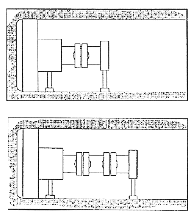
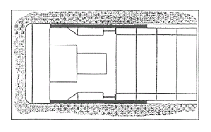

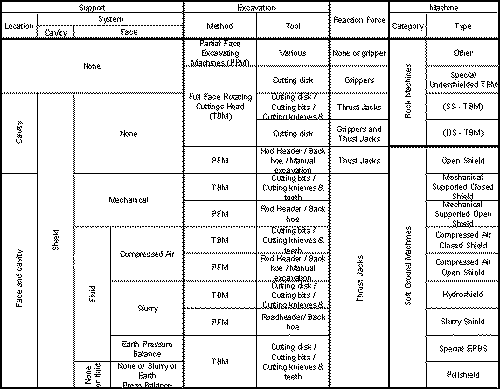
Rock tunnelling machines can be grouped into three main categories: Unshielded TBM, Single Shielded TBM and Double Shielded TBM which is the way of creating new types of TBMs that are suitable for application over a wider range of geological conditions, even though the distinction between TBMs for rock and TBMs for loose ground remains (figures 1,2,3).
In the above classifications (Table 1), neither reaming boring machines (with their sensitivity to the mechanical strength of the rock in the gripping area inside the pilot tunnel and to the possibility of instability of the reaming face) nor raise borers have been considered in the previous classification because these machines are of special or limited use.
Taking the rock TBM size into account, it is necessary to point out that, although today TBMs of more than 10 meters in excavation diameter have been constructed, it is always a good idea to try to limit the maximum dimension of the tunnel and therefore that of the TBM.
As can easily be perceived, the reasons for that are:
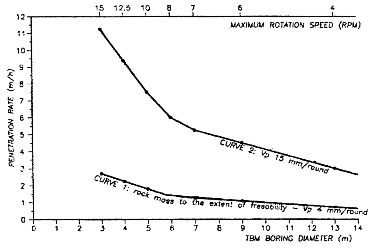
∙the potential of TBM in hard rock decreases with increasing diameter (Kovari, 1993; Bruland, 1998);
∙the maximum dimension of some of the major TBM components (for example the bearing and the head) has technological limits;
∙the intensity of both the instability phenomena and the convergence increases with increasing diameter of excavation (Tseng, 1998; Barla 1998; Barla and Pelizza, 2000).
Anyway, there is a positive and consolidated experience in the use of TBM in rocks of different qualities and strengths for up to 12 to 12.5m of excavation diameter; while beyond 13.5 to 14 m of excavation diameter, the actual technology of today is probably not up to the level of guaranteeing satisfactory performance of TBMs in hard rock.
Designers should take into account these limits during the tunnel design phase, making use whenever possible of the advantages offered by the reduced sections of the tunnel or even considering the possibility of having more tunnels running in parallel. This is particularly true for motorway tunnels where, in some cases, it is preferable to make triple tunnels each with two lanes for the traffic flow rather than twin tunnels each with three lanes. In the case of railway tunnels, it is better to have two relatively small, single-track tunnels, rather than a large, double-track tunnel.
A great help in the use of TBMs could possibly be acquired through the standardization of the section types of road, motorway, and railway tunnels: this could help the re-use of TBMs obtaining, at the same time, a constancy in the typology and quality of homogeneous construction works, in addition to gaining considerable advantages in construction times and costs.
3. Rock TBM selection
As is well known, the value of the TBM, in terms of direct project costs, is relatively insignificant. Failure to achieve the desired results and maintain the schedule, however, significantly affects the project. From the outset it is therefore important to adopt an approach of utilizing the best possible equipment, as far as all the aspects pertaining to the TBM and the supporting services are concerned.
The philosophy should be to design the TBM to perform at its greatest potential in the 90% of the situations and make some contingency provision for the 10% of the situation. Generally speaking, the most reliable machines are the simple ones as they have the least amount of equipment that can break down (Foster, 1997).

The TBM that is designed to cover all eventualities has, too frequently in the past, tended to be problematic in service and produces performances below expectations.
The main factor for the selection of tunnel boring machines is the interaction between the machine and the surrounding rock mass. The TBM performances mainly depend on the geological, hydrogeological and geotechnical conditions along the tunnel alignment but, also, on several other factors which include:
∙the geometrical and technical characteristics of the machine and its additional tools (i.e. exploratory drilling and ground reinforcement equipment);
∙the organisation of the working site, where continuos mucking with conveyor technology is a means of obtaining dramatic productivity increases (Peach 1995);
∙the experience of the contractor and of the machine drivers for the selection of a properly manufactured machine and on the proper “leading”, not only driving, of the machine (Grandori, 1996).
TBM standard performance can be evaluated on the basis of Rock Mass properties (Barton, 2000) but the performance is much more related with the occurrence, during excavation, of “limit working conditions” which have a great influence on time and costs of the construction of the tunnel (discussed in the following section 4).
For the design and construction of underground works, particularly tunnels, people are very often hesitant to choose between the Drill and Blast method and the TBM excavation technique. This is because there are many, diverse factors which influence the choice of advance systems (Lombardi, 1996).
When the excavation work should be carried out in long tunnels of constant, circular section and located in homogeneous and stable rock conditions, and when the available time for construction is short, the TBM technique, will no doubt be chosen if a TBM of the right diameter and good, qualified technical personnel are available and also if the economic situation of the project permits this choice. Otherwise, it is absolutely necessary to understand the significance of long tunnels and to give a precise definition to each particular case. The condition of circular tunnel sections is however not a necessity for the application of TBMs.
On the contrary, if the excavation work has to be carried out in short tunnels or cavities of irregular shape and sited in variable and unfavourable geological conditions, the choice of the Drill and Blast technique is obvious (Tarkoy, 1995).
In-between these two extreme theoretical cases, there exists an overlap zone which can lead to a great deal of questions such as:
∙is it correct to use the TBM technique when, in spite of the apparently favourable geological conditions, one risks encountering unforeseen or unforeseeable, delicate zones, from the geological point of view, which may stop construction progress and consequently lead to the loss of the financial and scheduling advantages usually offered by the TBM technique?
∙will the TBM technique be used for excavation of a short tunnel which is on the critical path of the scheduling of a large underground construction project, if it is known that the TBM solution will be expensive and that the access conditions are difficult ?
The problem, in the first case, is mainly technical, while, in the second case, it is of an economic nature.
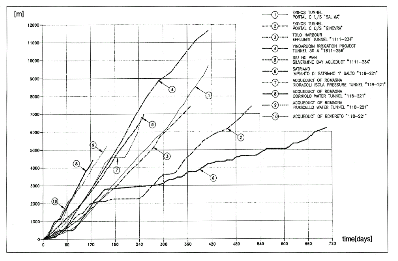
Despite the excellent performances of the TBM technique in favourable ground conditions, as reported in recent years (e.g., more than 1 km advancement for month for some hydraulic tunnels), it can be noted that, in many cases, the actual advancement rates were below expectations and certainly less than what were claimed by TBM manufacturers.
It would therefore be legitimate to think that, besides the unforeseen events, such as breakdowns or failure of the TBM components, the rock mechanics problems were often under-evaluated, or not considered at all.
The design has always had a deterministic approach, but reality of construction has never been so. This is due to the large number of uncertainties that cannot be avoided at the design stage: geological, geotechnical, hydrogeological, different types of machine available (new or used), and different construction techniques (Pelizza, 1999a).
Hence, at the design stage, it is impossible to know every aspect of the geological profile. It is therefore necessary to decide whether to optimise either the choice of the construction method or the selection of the machine for a given tunnel, on the basis of certain knowledge on the site geology and geotechnical conditions or of the predictions about these conditions (but up to which point are these predictions optimistic or pessimistic ?).
On the other hand, the problem of global optimisation is very complex, given the large number of geological, technological, environmental, and economic-financial variables involved. Nowadays, it is becoming possible to manage, in probabilistic terms, the decision strategies for tunnelling under uncertainty conditions involving various levels of variability (Einstein, 1996; Xu et al. 1996).


The fundamental problem is always determined by the physical and geotechnical heterogeneity of the geological formation in which the tunnel has to be constructed; for a full face, mechanised excavation, which is a rather rigid system, the strength heterogeneity of the material to be excavated, is even more important be it a rock or soil.
Prior knowledge, obtained in a correct manner, of the geological and geotechnical conditions of the site is fundamental for the development of underground works. Up to now, too little money has been spent on preliminary investigations. It has in fact been demonstrated that money spent on such investigations is greatly compensated by the savings made in terms of construction cost and time (Chapperon and Antonini, 1996) Forward probing from the pilot TBM tunnel and/or the main tunnel is not a complete alternative to an adequate pre-investigation.
Given that there does not exist a TBM capable of advancing always, whatever the geological situation is, it is also true that the overall result of a project depends very much on:
∙the type of the TBM used;
∙the design and special construction characteristics of the TBM used.
In fact, it is not enough to just order from a qualified manufacturer a particular type of TBM, instead, it is necessary a continuous collaboration and control of all design and construction details of the TBM by its destined user, the Contractor. This is particular true as far as there are still no “Accepted Standards” for the design and construction of a particular type of TBM, and each TBM to be made is a prototype one different from another, because:
∙the design and manufacturing of TBMs is a continuous, technological progress (innovation);
∙its tunnelling project has its own characteristics;
∙each specialised contractor has its own traditions and convictions.
Therefore the more correct procedure today is to execute in parallel the design of the tunnel and the design of the TBM.
On the basis of the above considerations and the recent and past experiences, it is possible to ascertain the following points regarding the selection of the type of TBM (some of which are obvious):
∙the shielded TBM have a wider range of application than the open shields;
∙this difference in the range of application increases with increasing diameter of excavation;
∙the open TBMs with a double system of grippers are more sensitive to unstable grounds than those with only a single system of grippers;
∙the wider or narrower range of application of a monoshield TBM, with respect to that of a double shield TBM, depends very much on the design and dimensioning of the TBMs themselves and on the type of limiting situations they have to face, rather than on the type of the TBM;
∙the choice between a monoshield TBM and a double shield TBM depends also on the design of the tunnel support and whether it is necessary to install precast linings along the entire length of the tunnel to be constructed.
∙some of the “limiting conditions” can be solved only by using special interventions (i.e. ground reinforcing, grouting, forepoling, etc.) with unavoidable consequences on the construction time and cost of the project.
The use of these techniques could be very difficult if the machine has not been equipped before the start of the works and it must be re-conditioned. As a consequence of this aspect it is necessary that the additional equipment (probe drilling, grouting, rock bolting, etc.) must be designed together with the TBM.
Furthermore it must never be forgotten that:
∙the specialisation of the contractor and, above all, the personnel director and technical staff on the site, plays a primary role in the functioning of a TBM, particularly under limiting conditions;
∙the major time and cost for overcoming limiting situation in a tunnelling project acquired through competitive bidding, should be supported by the Client who should take account of adequate margins in programming and budgeting for the project to be realised in difficult ground conditions according to the design assessment of risks. This point is valid also for tunnelling projects to be constructed by the Drill & Blast method.
4. Limiting geological conditions for the application of TBMs
It is possible to define “limiting situation” for a TBM when and where machine cannot work in the way for which it was designed and manufactured, and for this reason the advance of the TBM is significantly slowed down or even obstructed. With each limiting situation it is possible to associate some special interventions for overcoming it.
A geological situation is “limiting” not in an absolute sense, but only in relation to the type of the TBM used, its design and special characteristics, and eventually any operating errors.
A particular geological situation becomes a “limiting situation” only when it is beyond a certain dimension, or when the associated problems are beyond a certain level of severity, or else due to combination of events each of which is by itself not critical.
In the following it will be discussed those, relatively more important or frequent, limiting conditions. It should be pointed out that tunnel excavation by TBMs may encounter also other particular situations like clay soils, strong inflow of groundwater, drainage of groundwater and consequent settlement of the surface, gas, rocks and waters at high temperatures, and karstic cavities.
4.1 Borability limits
A rock is said to be not borable if the TBM cannot penetrate the face at a sufficient rate and/or the wear of the cutting tools exceeds an acceptable limit.
The borability of a formation should not be established in an absolute manner, but only relative to an alternative using the Drill and Blast technique, comparing the economical and scheduling aspects of both techniques.
The main index describing the capacity of a TBM to excavate a given rock is the penetration rate per revolution of the cutterhead which the TBM is able to achieve under the maximum thrust.
It is not possible to establish in a univocal manner a limit of penetration per revolution below which a formation shall be considered non borable. Such a limit is also influenced by the abrasivity of the rock and the diameter of the tunnel.
The high abrasivity, associated with low penetration, dictates frequent changes of cutters, increasing the cost for each cubic meter of rock excavated, in addition to the time lost in substituting the cutters.
With increase in the tunnel diameter there are three different effects which make the situation worse:
∙the rotation speed of the cutterhead should reduce for an equal penetration per revolution, because the bearings and seals of the disc cutters permit only a maximum speed equivalent to a circumferential speed of 150 m/min;
∙the number of cutters to be changed per meter of tunnel increased more time is, therefore, required for effectuating such operations;
∙the state of average wear of the cutters mounted on the head increases, thus decreasing the penetration per revolution.
Under extreme conditions, the above three factors excite each other until bringing the production to collapse.
For these reasons, a same formation may be borable for a TBM of small diameter, but not for a TBM of large diameter.
Nevertheless, to give some numbers for reference, penetration rates below 2~2.5 mm/rev are indicators of borability problems. Whereas an excavation starts to be efficient if the penetration rates are above 3~4 mm/rev.
Naturally, the theoretical performance of a TBM is affected by various activities strictly related to the functioning of the machine (CIRIA, 1988).
It happens rather often that the cutting wheel is pushed to a maximum in order to maintain an adequate penetration rate, even in high resistence rocks. If each part of the machine structure has not been planned and built to work under these conditions, the machine will vibrate in an anomalous manner and cracks gradually appear in the cutting wheel and gripper structures. As it is not easy to repair or substitute the cutting wheel in a tunnel, the consequent loss in production of the machine can be very serious.
4.2 Instability of the excavation walls
The instability of the excavation walls is a limiting characteristic for the open type of TBMs for rock.
The problem manifests when the phenomena of instability occur immediately behind the support of the cutterhead, making difficult both the installation of important supporting elements and the correct positioning of the grippers.
The consequences of the instabilities on the production and on the methods employed to overcome the instabilities vary enormously in function of:
∙the magnitude and the type of the instability phenomena;
∙the type of the TBM used (a simple or a double system of grippers);
∙the design and characteristics of the TBM;
∙the dimensions of the tunnel;
∙the system installed inside the TBM for installation of tunnel supports, and the type of supports itself.
In very serious situations, the daily advance may reduce to 1~2 meters, or even to zero.
The shielded TBMs for rock, single shield or double shield, are not very sensitive to the instability phenomena of the excavation walls since it is possible to install a precast-concrete or steel lining inside and under the protection of the shield and pushing against the lining it is thus possible for the TBMs to advance.
In the case of medium to large diameter tunnels (from 6 to 12m) the difference in the behaviour and productivity between open TBMs and shielded TBMs, under the conditions of excavation wall instabilities, increases considerable till even orders of magnitude, the advantages being naturally on the side of the shielded TBMs.
With Open TBMs the possibility of counteracting effectively against the instability phenomena at the excavation walls depends on the following interventions:
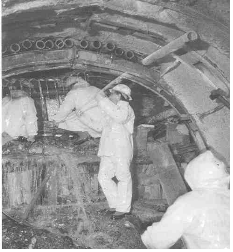
∙stabilisation and reconstruction of the walls, executed immediately behind the support of the cutting head using steel arches, wood lagging and shotcrete. The installation of these supporting elements, particularly the shotcrete, in this delicate zone of the machine requires long times and also risks to damage the excavation equipment;
∙traditional excavation in front of the TBM, often top heading (Tseng, 1998);
∙pre-treatment of the rock in the excavation front through boring and injection, or the installing forepoling above the TBM.
The main problem here, is that the phenomena of strong instability of the excavation walls may involve important length of the tunnel, especially when it is of large diameter, even if the quality of the rock is, technically speaking, not necessarily very poor.
Under these circumstances the choice is either to withdraw the TBM from the tunnel, or to accept serious delays.
4.3 Instability of the excavation face
When the state of fracturing and/or weathering of the rock formation to be excavated is such that strong instabilities manifest at the excavation face with falling down of blocks and fine materials, which does not stop until equilibrium is attained causing large over-excavations, it is possible to arrive at a limiting situation for the functioning also of shielded TBMs for rock.
In this situation, the advance of the machine may be hampered for two fundamental reasons:
∙the cutting head can no longer rotate because the accumulated, failed materials press against or block the head;
∙the over-excavation caused by the slide is such that it has formed caverns in front of the TBM, which suggests to stop the advance and treat the problem before the situation self excites and eventually becomes uncontrollable.
This is a typical limiting situation which also affects shielded TBMs of any type (Barla, 1998; Tseng, 1998).
According to the recent experiences (gained from Evinos (Greece), Yellow River (China), Pinglin (Taiwan) tunnels), to prevent such situations from occurring it is necessary that the TBM should be designed with the cutting head protruding outside the shield as less as possible, allowing the shield itself to support the excavation as close to the face as possible. In addition, it is also true that under these limiting conditions, being capable of yielding a high level of cutterhead moment both during starting up and during excavation and being capable of adjusting the rotation speed of the head itself, are of great help.
Furthermore, the cutting head should be designed without protrusion and without adjustable buckets. With these improvements in the machine construction, it is only possible to move the limits towards those situations which are truly exceptional, but not eliminating completely such limits.
In these cases, the frequently used interventions are:
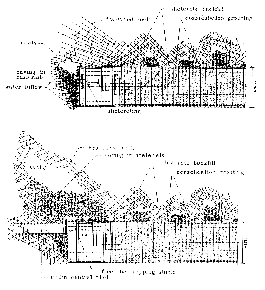
∙grouting of the collapse volume and backfilling of the cavity with resins and foams in order to create a kind of artificial conglomerate; the drilling and grouting are usually performed through special holes in the cutting head, which should have an accessible, internal cavity with adequate dimensions to permit such operations;
|
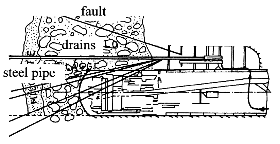
∙excavation of a by-pass tunnel (preferably on the roof of the machine) to free the cutterhead, to stabilize the collapse and to realize a section of the tunnel using conventional excavation, or consolidate the ground through grouting and forepoling.
The execution of an umbrella by drilling and injection through the special holes in the shield has not been demonstrated till now to be of big help in overcoming such exceptional situations, because the holes arranged in the shield are widely spaced (for the functioning of other components of the TBM) and diverge towards the face, thus not permitting a sufficiently effective treatment of the ground.
Nevertheless, a complete set of equipment and treatment material (grouting pumps, drilling machines, drill bits and rods, resins, foams, etc.) should be maintained at the construction site for the special remedial operations, in order to limit the duration of stops for ground treatment (except for exceptional events) to a few days; otherwise, such stops may last weeks or even months.
4.4 Crossing fault zones
When crossing a fault zone the excavation face may behave like a fluid under pressure and seek to flood the tunnel, if the ground is completely weathered and groundwater under pressure is also present.
If an open TBM encounters this kind of situation without having pre-identified it using probe drilling, the TBM may be filled by the collapse leading to a difficult-to-reverse situation.
Whereas the same situation is encountered by a shielded TBM for rock, be it a single or double shield, may not be so catastrophic, although it is certainly not possible to continue the excavation, but at least it is possible to treat the collapsed area from inside the shield and to stop the tunnel from being completely filled thanks also to the concrete lining which constitutes a natural extension of the shield.
4.5 Tunnels in squeezing ground
A TBM is in difficulty if the phenomenon of tunnel convergence, doesn't matter its origin, manifests with considerable magnitude at a short distance from the face (a few meters) within periods of time shorter than 4~8 hours.
This is a limiting situation very much concerned by designers but not often happens in reality, such that stops of rock TBMs for long periods of time due to convergence problems have recently not been heard while instead the problems of overcoming face collapsed have been reported frequently.
On the other hand, the medium-to-long- term- convergence related problems are perhaps more frequently registered where the tunnels supported exhibit the common phenomena of floor heaving and support collapsing.
Shielded TBM are notoriously sensitive to the phenomena of rapid convergence and, in the absence of special technical precautions, they risk to be trapped frequently by the converging rock (Lombardi, 1997).
For the open type of TBMs, if the phenomena of convergence are very rapid and are associated with instabilities, as often proves to be, great problems of support installation and gripping may occur, hampering the advance of the excavation.
For most TBMs it is foreseen the possibility of increasing the diameter of the cutting head (overcutting), aimed at adjusting the gap between the shield and the excavation periphery from the normal value of 6~8cm to 14~20cm.
Nevertheless, the major difficulty of open TBMs advancing in strongly converging and unstable ground conditions derive from the difficulty of installing supports like steel sets, wire meshes and shotcrete, and from their inability to counteract immediately the pressure and deformation of the ground.
With shielded TBMs the maximum thrust of longitudinal jacks can be increased until it reaches such a high level that permits the machine to advance also in the presence of high ground pressures (2~5MPa), provided that the segmental lining is sufficiently robust and capable of supplying the necessary reaction to the thrust jacks, otherwise, it will be the lining itself that will collapse.
These tactics, together with overcutting, allow shielded TBMs to advance in nearly every type of situations including also those so-called exceptional situations.
However, in cases where a TBM is forced to stop for a prolonged period of time due to mechanical breakdowns, in a zone of squeezing ground, the risk of the TBM being blocked becomes very high.
The operation of freeing the TBM is relatively easy with a double shield TBM, where it is possible to interfere at 4~5m from the face through opening up the telescopic zone of the TBM. Instead, for a single shield TBM, the freeing operation has to start from behind the tail of the TBM, demolishing one or two rings of the precast lining at about 8~9m from the face.
5. Conclusions
With the passing of time, the TBM stone-age has been transformed into on high-tech machine.
However, just as at the beginning of its earliest applications, the technology of mechanized full- face tunnel excavation has still to face the limits imposed by the local geology and the economic challenges and schedule competitions of the drill and blast technique;
Nevertheless, mechanised excavation using TBM is increasingly becoming a branch of industrial engineering and it should be dealt with, as such.
The advantages for the excavation activity, labor and environment safety, and performances are remarkable.