

1. INTRODUCTION
2. PROJECT OVERVIEW
2.1 General
2.2 Geology
3. COMMON RISKS ASSOCIATED WITH TUNNELING METHODS
3.1 NATM Tunneling
3.2 TBM Tunneling
4. RISK ASSESSMENT FOR TUNNELING METHODS
4.1 Analysis Methodology
4.2 Analysis Results
5. DISCUSSIONS AND CONCLUSIONS
1. INTRODUCTION
Underground construction involves inherent risks of geology and linear construction methods that have led to an unwanted reputation for late and over-priced projects around the world. Underground construction has also proven to be exceptionally risky for the insurance companies that underwrite projects for the construction industry. What contribute to increased risk on tunneling projects are limited pre-bid geotechnical investigations, unrealistic cost and schedule expectations, and inappropriate tunneling methodology. For this project the following are the most serious effects of risks associated with delivery of the tunnel:
•Failure to keep within the bid price
•Failure to achieve the required completion date
•Failure to meet required quality and operational requirements, and
•Experience of an unacceptable or potentially catastrophic event within, adjacent to or above the tunnel.
The assessment in this paper will focus on finding risks associated with the tunneling methods, especially TBM tunneling method and NATM, and determining the tunneling method presenting less risk to complete the project within the estimated bid price and the planned excavation duration. The success of tunnel project is mainly dependent upon achieving planned advance rates during excavation. The ability to recover the partially excavated tunnel in the event of a catastrophic face collapse or flooding of the tunnel should be considered in the risk assessment.
2. PROJECT OVERVIEW
2.1 General
The project requires 4.86 km of subsurface excavation providing a 4 lane urban expressway. The subsurface excavation has approximately 4.08 km in tunnel with another 0.63 km of box structure and 0.15 km of U-type section. The tunnel is located as deep as 50 m below the ground surface and partially excavated under a river. A number of different alignments and profiles were considered, and the following items were considered in selection of the tunnel alignment:
•Tunnel design, including length, depth, dimensions, shape, and proximity of one tunnel bore to the other
•Historical excavation experience in the area
•Ground conditions, in particular known and potential faults zones including intersecting faults
•Available site access and logistics
•Surface impacts, structures along the alignment, portal locations, and
•Proximity to the river and possibility of flooding.
The estimated cost of the project is 375.7 billion Korean Won (US$330 million) with anticipated construction duration of 2,100 days.
2.2 Geology
The regional geology consists of Pre-Cambrian banded gneiss with well developed foliation, heavily faulted with mica gneiss and dykes in some parts, overlain with thick alluvial deposits consisting of mainly sands and gravels (Samsung C&T, 2010a). There are two predominant sets of lineaments NNE-SSW to NNW–SSE. The tunnel alignment is close to the lineament that follows the river (NW-SE). The tunnel portals are located in the old alluvial flood plains.
The river itself is a large geologic structure and contains several faults and shear zones. Rock strengths encountered in construction of these other projects were as high as 200 MPa. However, mixed faces of high strength rock and completely weathered rock with dyke intrusions were also encountered.
Some detail geologic information is provided from tunnel projects in the project area. Alluvial deposits (sands, gravels and cobbles) were encountered at a depth of 30 m. The top of bedrock fluctuated between 10 m and 30 m from the surface and mixed faces of gravel – weathered rock – bedrock were encountered. Generally rock strengths varied between 87 MPa and 187 MPa, with quartz content in the range of 35% - 40% and up to 60%.
The tunnels will be constructed mainly in hard gneiss through multiple faults (13 identified and 3 suspected) and there will be an inevitable degree of uncertainty regarding the conditions that will be encountered including, in particular, the hydrogeological conditions. The geological information indicates that the ground conditions are likely to be highly variable and that water inflows are likely to be encountered from discontinuities in the rock, including joints, faults and dykes at and around tunnel depth. In addition to anticipated water seepage through the joints, when tunneling adjacent to and beneath the river, there is an increased likelihood of significant ground water inflows from wider conductive joints and fault zones.
The geological profile indicates a number of areas where the ground conditions are likely to be very poor and problematic for tunneling. The conditions indicated include:
•Mixed face conditions of rock and soil materials
•Highly variable rock strengths
•Fractured rock in or near known or suspected and/or possible fault zones
•The presence of fractured or highly fractured rock in areas other than fault zones
•Localized weathering in the known, suspected and/or possible fault zones and dykes
•Areas of closely spaced joints
•Highly altered and/or gouge material present in faults and dykes
•Stiff blocks embedded in soft matrix
•Adversely oriented discontinuities and or low angle shear zones
•Abrasive mineralogy
Five rock classifications have been identified, varying in rock mass properties. The average permeability ranges from 4.4×10⁻⁴ cm/sec in the fault zones to 6.2×10⁻⁷ cm/sec in Type I. Young’s modulus ranges from 50 MPa to 23,000 MPa and unconfined compressive strengths range from 240 MPa in rock Type I to 55 MPa in rock Type V. Approximately 70% of the tunnel alignment is expected to be in Type III and IV ground. Rock strength difference could vary up to 30 times within the same cross section face area.
However, approximately 15% of the tunnel alignment appears to cross faults up to 25 m to 32 m wide with mostly unfavorable orientations (parallel to the tunnel alignment or against the dip), multiple intersecting faults, dykes and shear zones of jointed rock, crushed rock in a matrix of sand and gravel and or weathered rock. Graphite is present in the fault zones which would be clay like under the influence of water.
There is a wide scatter in the rock mass rating (RMR) from a low of 20 to a high of 80, which would indicate less predictability and more potential for deformation. The brecciated or gouge material in the fault zones appears to be severely fractured to crushed almost gravel–like with zero shear strength. This could correspond to the very high permeabilities in these zones.
3.COMMON RISKS ASSOCIATED WITH TUNNELING METHODS
3.1 NATM Tunneling
There are a number of collapses and failures of NATM tunnels in weak rock and soft ground that have resulted in damage to buildings and infrastructure, serious injury and loss of life. The types of collapses that typically occur are:
•Rock falls due to inadequate support
•Crown failures where soil flows into the tunnel under high water pressures
•Local or full face failures where a part or full of the working face runs into the tunnel
•Bench failures where a part or the entire of bench slides transversely or longitudinally into the tunnel
•Washout failures
•Pipe failures
Other types of failure that occur are failures of the lining before and after ring closure, bearing failure of the arch footings, failure due to horizontal movement of the arch footings, and shear failure of the side of the gallery walls. Causes of these collapses are generally attributed to unpredicted geological condition, and technical mistakes on planning, calculation, construction and management.
3.2 TBM Tunneling
The constraint of storing precast concrete segments at the construction staging area needs to be considered in the risk assessment. There is a common rule of thumb that “double the average advance rate will be achieved sometime during the project.” For an average advance rate of 7 m/day, a peak production rate of 14 m/day would be achieved (Samsung C&T, 2010b). Assuming that approximately 1 week’s worth of segments would need to be stored at any one time, this would translate to approximately 40 full rings of segments, which would require a minimum footprint of approximately 800 m2 at the portal, plus an allowance for a gantry crane. The delivery and movement of segments to the portal will also have space limitations.
If the muck is conditioned from an EPB TBM operation, the muck would need to be spread for approximately a week to allow for the muck to dry. The muck pit at the portal would need to be sized to accommodate the multiple loading points and to provide sufficient storage for downtimes when hauling operations are not permitted.
The rock type, rock strength and joint structure are the most fundamental factors governing the boreability and hence TBM advance rate. A “blocky” rock face will inhibit the ability to efficiently cut the rock, and will cause vibrations and accelerated cutter wear if full thrust pressures are maintained. Fall out of hard blocks from a soft matrix caused cutterhead blockages, overloading of conveyor systems, and increased vibrations leading to increased wear on the machines, including the main bearings. High water inflows would also cause fall out of hard blocks and exaggerate overbreak combined with washout of gouge material.
4.RISK ASSESSMENT FOR TUNNELING METHODS
4.1 Analysis Methodology
In this risk assessment, an attempt has been made to assess risks both from a qualitative and quantitative perspective. Risk impacts have two components – cost and schedule. From a qualitative perspective, risks need to be identified and prioritized. For this purpose risk can be assessed as low, medium or high risks based upon a predetermined set of impact values for each category (schedule delay, cost increase and probability of risk occurring) as given in Table 1. The cost and schedule impacts need to take into consideration the possible cumulative risk impact as many risks have the potential for multiple occurrences during repetitive tunneling operation.
A listing and qualitative comparison of risks that have the potential of impacting construction of the project when comparing TBM and NATM approaches are contained in Tables 2, 3 and 4 (Barla and Pelizza, 2000; Barton, 2000; Holen and Anlegg, 1998; Huang, 2008; Tarkoy, 1996; Kim et al, 2002). The probability of encountering each risk factor was assessed using an analysis of historic data on similar projects. The discrete risk events that were considered in the modeling are presented in Table 2. Tables 3 and 4 present the risks that were taken into account when considering the uncertainty in the advance rates for each of the methods. Most events described in Tables 2, 3 and 4 can be characterized by impacting the productivity or advance rates achieved in excavation and installation of ground support. The impact of risks can be captured as uncertainty about activities in the construction schedule. It should be noted that the qualitative comparison of risks is only applied to this tunnel project with specific geological conditions and other contract requirements.
Uncertainty about the construction duration was applied based upon optimistic, most likely and pessimistic advance rates for both the NATM and TBM methods. These ranges of advance rate are presented in the Tables 5 and 6 (Samsung C&T, 2010b). Advance rates for the NATM approach were assessed based upon 9 groups of support categories, as shown in Table 5. Similarly, TBM advance rates were assessed in the five predominant ground types I through V, as shown in Table 6. Normal practice is to assess the most likely advance rates in various ground conditions requiring varying levels of excavation sequencing and ground support.
The base tunnel construction cost was assumed as 200 billion Korean Won for both tunneling methods. The NATM and TBM tunneling costs breakdown can not be given in this paper. Although the base tunneling cost is not as exact as building up a proper cost estimate for the project, the prototypical cost estimate for similar size tunnels was used and it is considered as a reasonable comparison for purposes of the risk assessment. Accuracy was considered less important than determining if there were orders of magnitude differences in cost when risk and uncertainty was applied to each of the construction alternatives.
The risk analysis was completed using Monte Carlo simulation in Primavera Risk Analysis. Monte Carlo simulation is a simulation technique for forecasting the range of results most likely
to occur. In this technique, each input variable is sampled at random from its probability distribution, and the input variables are integrated to calculate the response variable. This process is repeated to obtain a large set of values of the response variable. From this set, one can calculate the range of the response variable associated with specified confidence levels.
4.2 Analysis Results
It would appear that, assuming there are adequate skilled labor resources available to drive multiple headings consecutively, advance rates with the NATM approach in these ground conditions, although slower than the TBM approach, are more predictable (Parsons Brinckerhoff, 2010). Risks, however, are prevalent when tunneling in such varied rock masses. Risks likely to slow advance rates include flooding, collapse of the face, rock spalling, slabbing and or rock wedge falls. Unconsolidated material within or in close proximity to the fault zones, or standing under water pressure may cause immediate collapse at the face if exposed before adequate treatment.
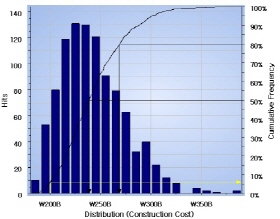
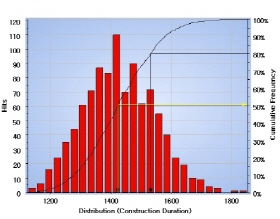
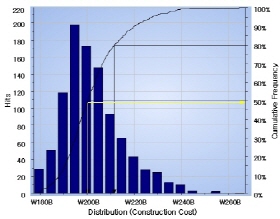
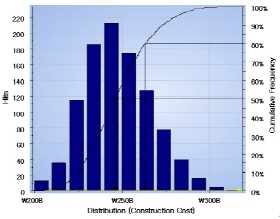
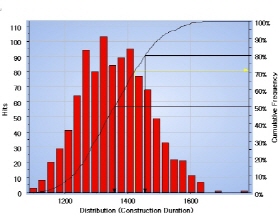
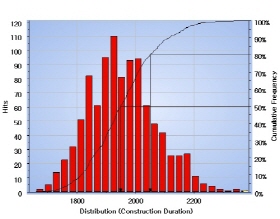
The analysis results using Monte Carlo simulation are shown in Fig. 1 and 2. These costs reflect tunneling costs in current year. Extended overhead costs were considered to be 97 million Korean Won for each working day beyond the deterministic completion date until project completion (Parsons Brinckerhoff, 2010). The analysis results are summarized in Tables 7 and 8.
A robust construction schedule incorporates the best estimate of the duration activity, correct logic between successive and interconnecting activities, uncertainty and risk. If only the uncertainty in productivity (i.e. advance rates) is considered for the analysis, it would appear that there is a reasonably high confidence (> 70%) that the planned 57 months from mobilization to completion of tunnel excavation and lining for the NATM approach can be achieved. However if discrete risk events are taken into consideration the confidence level reduces to 50%.
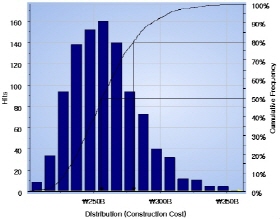
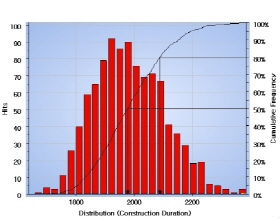
The TBM approach appears more unpredictable and therefore presents a higher risk. If uncertainty inadvance rates is applied to each of the five ground types there is very low confidence (< 1%) that the planned 65 months between mobilization and completion of tunnel excavation can be achieved and that the project can be completed at or under the estimated cost. There is a 50% probability that tunneling (assuming one TBM) could take 78 months or longer.
An analysis was performed to assess the sensitivity of the tunnel advance rates to the output of the risk analysis. The optimistic daily advance rates for the TBM were doubled in the model. The outcome was that this reduced the 50% probability of achieving completion of tunneling (assuming one TBM) from 78 months to 74 months. This would indicate, as expected, that in these ground conditions the success of the TBM option is more dependent upon the occurrence (or non-occurrence) of risk events than it is by general uncertainty in advance rates.
5. DISCUSSIONS AND CONCLUSIONS
A comparative risk analysis of TBM against NATM tunneling was carried out in this paper. The main purpose of this study is to assess whether the project using NATM or TBM method can achieve the planned excavation duration and bring the project within the estimated bid price. The analysis results would help to decide which tunneling method alternative needs to be selected to complete the mixed-face large urban tunnel project with the least time and cost. For NATM, the risk analysis found that the project had a 72% confidence in completing the project within the estimated time and a 49% confidence in completing the project at or under the estimated cost. For the TBM method, the risk analysis found that the project had a <1% confidence in completing the project within the estimated time and a <1% confidence in completing the project at or under the estimated cost. It should be noted that the risk analysis is only applied to this tunnel project with specific geological conditions and other contract requirements.
Risk in tunneling is unavoidable, and a risk management and mitigation plan should be implemented to manage risks to an acceptable level. Thorough and transparent risk management systems have proven effective and beneficial on major projects all over the world. There are several actions required to ensure that the risk management framework can be carried forward through the project design and construction stages. The following are some recommendations of tasks and strategic planning arrangements and on how the risk management process moves forward (URS, 2005).
•Create a risk management manual for the project that will provide a detailed framework of how each aspect of the risk management program fits with the ongoing project tasks
•Designate a Project Risk Coordinator that has overall responsibility for maintenance of the risk management program and coordinates the various risk registers in use.
•Carry out independent audits on the overall project risk register, including all the cascading work activity risk registers
•Generate and maintain risk registers at the work activity level. The owner must make sure that relevant risk registers are transferred as part of the design builder’s Contract so that they become part of the project requirements